


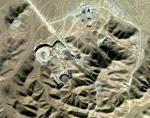
 Reuters: Iran is believed to be further increasing its uranium enrichment capacity at its Fordow plant buried deep underground, Western diplomats say, in another sign of Tehran defying international demands to curb its disputed nuclear program.
By Fredrik Dahl
 VIENNA (Reuters) – Iran is believed to be further increasing its uranium enrichment capacity at its Fordow plant buried deep underground, Western diplomats say, in another sign of Tehran defying international demands to curb its disputed nuclear program.
But they said the Islamic Republic did not yet appear to have started up the newly-installed centrifuges to boost production of material which Iran says is for reactor fuel but which can also have military uses if processed more.
“Iran continues to build up enrichment capacity,” one Western official said.
A diplomat accredited to the U.N. International Atomic Energy Agency (IAEA) said: “We think that they have continued installing centrifuges at Fordow. We think that their pace has continued the same as it was, which was pretty rapid.”
If confirmed in the next IAEA report on Iran’s atomic activities, expected in mid-November, it would suggest Iran is steadily moving towards completing installment of centrifuges at the Fordow subterranean centrifuge site.
The work may be “near complete,” the Vienna-based diplomat said, in remarks echoed by another envoy.
There was no immediate comment from Iran or the IAEA, the U.N. nuclear agency based in the Austrian capital.
Fordow – which Tehran only disclosed the existence of in 2009 after learning that Western spy services had detected it – is of particular concern for the United States and its allies as Iran uses it for its higher-grade enrichment.
Iran says it needs uranium refined to a fissile concentration of 20 percent, compared with the level of up to 5 percent it produces at its main enrichment facility at Natanz, to make fuel for a medical research reactor in Tehran.
STALLED DIPLOMACY
But it also takes Iran a significant technical step closer to the 90 percent concentration needed for bombs, explaining the West’s growing concern about the Islamic state’s stockpile of the material.
A U.S.-based think-tank, the Institute for Science and International Security (ISIS), this month said Iran would currently need at least two to four months to produce enough weapons-grade uranium for one nuclear bomb, and additional time to make the device itself.
Last week, Iranian officials said Tehran would negotiate on halting higher-grade enrichment if given fuel for the research reactor, in a possible attempt to show flexibility in stalled nuclear talks with world powers.
The IAEA said in its last report on Iran in late August that the country had doubled the number of centrifuges to 2,140 at Fordow since the previous report in May. More than 600 remained to be installed, the report showed.
Since then, diplomats said they thought Iran had put in place more centrifuges at the site near the holy Shi’ite Muslim city of Qom, about 130 km (80 miles) from Tehran and located deep under soil and rock for protection against any attack.
“They continue sort of unabated,” one envoy said.
But they said Iran was still operating the same number of machines as it has been since early this year, nearly 700 centrifuges.
It was not clear when the new equipment would be launched or whether Iran was holding back for technical or political reasons. It is also not known whether the centrifuges which are not yet operating will be used for 5 or 20 percent enrichment, or both, the diplomats say.
Any move by Iran to increase the number of working centrifuges – and the production rate – would be swiftly condemned by its foes in the West and Israel and may further complicate diplomacy aimed at resolving the dispute.
Iran says its nuclear program is a peaceful project to generate electricity but its refusal to limit the work and lack of transparency with U.N. inspectors have been met with increasingly tough Western sanctions targeting its oil exports.
European Union governments imposed sanctions on Tuesday against major Iranian state companies in the oil and gas industry, and strengthened restrictions on the central bank, cranking up financial pressure on Tehran.
(Editing by Jon Hemming)


