


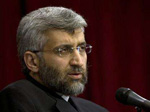
 Bloomberg: At the end of multi-party talks today about its nuclear program, Iran’s chief negotiator Saeed Jalili called the two-day session in Kazakhstan a “turning point.” Did he mean it, or was he stretching out negotiations to buy time for the expansion of Iran’s capacity to build nuclear arms? Bloomberg
By Lisa Beyer
At the end of multi-party talks today about its nuclear program, Iran’s chief negotiator Saeed Jalili called the two-day session in Kazakhstan a “turning point.” Did he mean it, or was he stretching out negotiations to buy time for the expansion of Iran’s capacity to build nuclear arms?
Iran’s interlocutors — China, France, Germany, Russia, the U.K. and the U.S. — will have a better idea once Iran officially responds to their latest proposal to ease sanctions in exchange for Iran’s curtailing of its nuclear program. Technical experts are to meet next in Istanbul on March 18, with high-level negotiations resuming in Kazakhstan on April 5.
In the meantime, there is some reason to think Jalili may have been sincere. From Iran’s point of view, the latest offer is an improvement over previous ones, with face-saving features. The world powers dropped their insistence that Iran shutter its fortified uranium-enrichment facility at Fordow, even if they continue to demand a suspension of the production of 20-percent enrichment uranium there.
The proposal would limit Iran’s ability to stockpile 20-percent enriched uranium, material that can be upgraded relatively quickly to weapons-grade uranium. Yet it would permit Iran to continue making some of the material for use in the Tehran Research Reactor, which Iran says is for the production of medical isotopes.
For countries worried about an Iranian nuclear bomb, the proposal offers tougher monitoring of Iran’s enrichment facilities by the International Atomic Energy Agency. This is especially vital now that Iran is adding centrifuges at a rapid rate and installing advanced devices that are four to five times more productive than older models. This expanded capacity could enable Iran, in time, to produce sufficient fissile material for a nuclear bomb before inspectors, under the current regime, detected such an effort. More frequent monitoring could help protect against such a possibility.
(Lisa Beyer is a member of the Bloomberg View editorial board.)


