


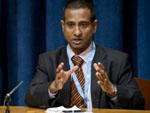
 New York Times: With presidential elections approaching in June, Iran has cracked down on journalists, rights activists and lawyers apparently in a bid to stifle dissent, a United Nations investigator said on Tuesday. The New York Times
By NICK CUMMING-BRUCE
 GENEVA — With presidential elections approaching in June, Iran has cracked down on journalists, rights activists and lawyers apparently in a bid to stifle dissent, a United Nations investigator said on Tuesday. He also said that the judicial authorities in Iran had tortured some Iranians for contacting him.
Iran rejected the assertions by the investigator, Ahmed Shaheed, calling them unfounded propaganda done under pressure of the West to malign the country. Iranian officials have issued similar rejoinders to the reports of Mr. Shaheed, a former foreign minister of the Maldives, since he was appointed to the role after the repression of antigovernment protests over the disputed Iranian presidential elections of 2009.
“The human rights situation in Iran has been worsening, is continuing to worsen,” said Mr. Shaheed, whose official title is United Nations special rapporteur on the situation of human rights in the Islamic Republic of Iran. Speaking to reporters after briefing the United Nations Human Rights Council, he said, “I characterize the situation as one of widespread violations that are systemic and systematic.”
He asserted that rights abuses, including what he called “serious torture,” had been carried out across a wide section of society, affecting people engaged in a range of activities.
Mr. Shaheed expressed particular concern for the situation of journalists, rights activists and prominent lawyers defending politically sensitive cases or working with organizations promoting human rights who were facing long prison sentences or long bans on their ability to practice their professions. In a statement to the council, he said they “continue to be subjected to harassment, arrest, interrogation and torture, and are frequently charged with vaguely defined national security crimes, which is seemingly meant to erode the front line of human rights defense in the country.”
The Iranian authorities arrested at least 17 journalists this year, charging nearly all of them with communicating with “anti-revolutionary” international news organizations or human rights organizations, he said. An additional 45 journalists were already in detention at the start of the year.
“With elections round the corner in June, these sort of accusations do not bode well for the prospect of free and fair elections in the country,” he said.
As further evidence of Iranian authorities’ determination to shut off such contacts, they had charged five Kurdish prisoners with “contacting the office of the special rapporteur,” Mr. Shaheed told the council.
“These prisoners were reportedly interrogated and severely tortured for the purpose of soliciting confessions about their alleged contact with me.”
He also expressed concern about Iran’s high rate of executions, reporting 497 executions in 2012, of which about half were conducted in “secret” — meaning families and lawyers of the condemned had not been given advance notice. Fifty-eight executions were staged as a public spectacle, he said.
About 80 percent of executions were carried out for drug-related offenses that are not a capital crime under international law, Mr. Shaheed said. In his review of capital cases, he found what he called frequent reports of forced confessions, inadequate opportunities for defense and widespread disregard for legal safeguards.
Iran’s delegate at the council, Mohammad Larijani, called Mr. Shaheed’s report “a compilation of unfounded allegations.” It was, he said, “the product of an unhealthy, nonobjective and counterproductive exercise initiated by the United States of America and its European allies.”
Mr. Shaheed said he had been unable to visit Iran because it refused to cooperate with his investigations but noted that his report was based on 169 interviews, two-thirds of them inside Iran and corroborated what he called independent sources. “I think I established beyond reasonable doubt that my information is valid,” he said in an interview.
He also said he believed that Iran cared about what is said about it in the council, the media or other public outlets, which had sometimes led to what he called positive measures by the Iranian authorities.
“At least a dozen lives were saved because of the intervention of international opinion,” Mr. Shaheed said.


