


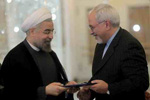
 AFP: Iranian President Hassan Rowhani has tasked the foreign ministry with handling the country’s sensitive nuclear talks, his website said Thursday, in a possible signal of a less confrontational approach with world powers.
By Siavosh Ghazi
TEHRAN (AFP) — Iranian President Hassan Rowhani has tasked the foreign ministry with handling the country’s sensitive nuclear talks, his website said Thursday, in a possible signal of a less confrontational approach with world powers.
The announcement comes as Iran and the UN atomic watchdog are set to resume talks in Vienna on September 27 over Tehran’s controversial nuclear programme.
Western countries and Israel accuse Iran of using its nuclear programme as a cover to develop weapons capability, an ambition Tehran strongly denies.
The International Atomic Energy Agency (IAEA) has been probing the programme for a decade, and Tehran has been slapped with a number of international sanctions for its refusal to stop enriching uranium, a process that can lead to producing the fissile core of an atomic weapon.
Under Rowhani’s controversial predecessor, Mahmoud Ahmadinejad, Iran’s nuclear dossier was handled by unyielding hardliners, but the new president has indicated that he is seeking a solution.
Until now, Tehran’s point man has been Saeed Jalili, head of the Supreme National Security Council. That follows a tradition dating back to 2003, when Rowhani himself headed the council.
It was not immediately clear, but Thursday’s announcement would seem to indicate that Zarif, a moderate who worked under Rowhani in those days and who has lived in the West and negotiated with it, would take on the role personally.
The announcement was called “encouraging” by one Western diplomat in Tehran.
“The idea is to transform the nature of the dossier, making it more technical, focusing on the nuclear programme, and less warlike, building an atomic bomb,” he said.
Last month, Rowhani named ex-foreign minister Ali Akbar Salehi to head the country’s Atomic Energy Organisation and career diplomat Reza Najafi as envoy to the UN nuclear watchdog, the International Atomic Energy Agency.
But some diplomats question to what extent Rowhani and his new team will have a free hand in the talks, as supreme leader Ayatollah Ali Khamenei has a final say in the matter.
Western powers hope that Rowhani will breathe new life into efforts to resolve the nuclear issue.
During his role as Iran’s chief nuclear negotiator, he accepted the suspension of the enrichment programme.
Indeed, Rowhani said last month Iran was ready for serious talks, with greater transparency. But he said there could be no surrender of the right to the peaceful use of nuclear energy and that Iran would not give up uranium enrichment.
Talks between Tehran and major world powers have so far failed to yield an agreement.
The last round of discussions were held in mid-May, before the election of Rowhani, who was Tehran’s chief nuclear negotiator under reformist president Mohammad Khatami.
The IAEA and Iran have held 10 rounds of failed meetings since the November 2011 publication of a major IAEA report on Tehran’s nuclear programme.
The IAEA wants Iran to grant access to sites, documents and scientists involved in Tehran’s alleged efforts to develop atomic weapons, which the agency suspects mostly took place before 2003 but are possibly still ongoing.
Iran says the IAEA’s findings are based on faulty intelligence from foreign spy agencies such as the CIA and Israel’s Mossad — intelligence it complains it has not even been allowed to see.
In its quarterly report, seen by AFP last week, the IAEA said Iran had installed hundreds more centrifuges since May that could enable it to enrich uranium faster. That would allow it to obtain the amount of fissile material needed for a nuclear bomb more quickly, if it wished to go down that path.
Parallel talks between Tehran and the six powers — the so-called P5+1 composed of the United States, Russia, China, Britain, France and Germany — have been stalled since April.
In addition to the IAEA talks in Vienna, Rowhani and Zarif plan to attend the UN General Assembly in New York later this month. There, the foreign minister is expected to meet Catherine Ashton, the P5+1’s chief negotiator, as well as some of his counterparts from the group.


