


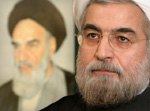
 AFP: Iranian President Hassan Rowhani said Tuesday Tehran will not give up “one iota” of its nuclear rights, echoing his hardline predecessor, while warning world powers the timeframe for negotiation was not unlimited.
By Mohammad Davari
TEHRAN (AFP) — Iranian President Hassan Rowhani said Tuesday Tehran will not give up “one iota” of its nuclear rights, echoing his hardline predecessor, while warning world powers the timeframe for negotiation was not unlimited.
He spoke ahead of a meeting later this month between Foreign Minister Mohammad Javad Zarif and EU foreign policy chief Catherine Ashton on restarting negotiations on the Islamic republic’s disputed nuclear ambitions.
“Our government will not give up one iota of its absolute rights” in its nuclear activities, said Rowhani, repeating a mantra frequently used by his predecessor, Mahmoud Ahmadinejad.
Speaking to state television later in the evening, Rowhani said his administration had the “necessary determination and mechanism” to “step by step” remove suspicions by Western powers and Israel that Iran’s nuclear drive is a cover to build a bomb despite repeated denials by Tehran.
But he warned that “the period of time for resolving the nuclear issue will not be limitless” — suggesting without elaboration that his June 14 election had created an “opportunity” within the regime to end the nuclear showdown.
“The world should take advantage of this period and the opportunity that our nation created by (my) election,” he charged.
Meanwhile, Rowhani claimed, without elaborating, to have the tacit support of supreme leader Ayatollah Ali Khamenei — responsible for all final decisions on the nuclear issue — “for flexibility” in the talks.
Tehran and world powers have failed to achieve a breakthrough in years of talks. Iran, during Ahmadinejad’s two-terms as president, refused to make any concessions on the nuclear programme.
That has led to several sets of international sanctions being slapped on the country, crucially targeting its oil sector and access to the global banking system, choking the economy and stoking a raging inflation.
Those measures are designed to coerce Iran to cut back on its drive, in particular its sensitive enrichment activities, and force it to increase cooperation with the International Atomic Energy Agency (IAEA).
But Rowhani has ruled out any halt to the nuclear programme.
“One of Iran’s rights is to enrich (uranium) on its soil but with regards to international regulations, while being under the supervision of the agency and for peaceful” purposes, he said in his live remarks to state television.
In parallel efforts, the IAEA is urging Tehran to provide necessary cooperation to remove suspicions it seeks a nuclear weapons capability, ahead of its scheduled September 27 meeting with Iran.
“Given the nature and extent of credible information available to the agency about possible military dimensions to Iran’s nuclear programme, it remains essential and urgent for Iran to engage with us on the substance of these concerns,” IAEA chief Yukiya Amano said Monday.
Rowhani did not directly address those concerns but said “threats and pressure” would not obtain any result.
He added that after the Zarif-Ashton meeting in New York, nuclear negotiations would “continue in another place with the P5+1,” which groups the United States, Russia, China, France, Britain and Germany.
Himself a former nuclear negotiator, Rowhani has reshuffled top officials dealing with the programme, appointing a new envoy to the IAEA, Reza Najafi, and former foreign minister Ali Akbar Salehi to head Iran’s Atomic Energy Organisation.
And last week he handed responsibility for future talks with the P5+1 to the foreign ministry.
Under Ahmadinejad, the hardline Supreme National Security Council was directly in charge of the talks, with its secretary Saeed Jalili leading Iranian negotiators in several rounds of fruitless negotiations.
Earlier in the day, foreign ministry spokeswoman Marzieh Afkham said the council would not be eliminated from the process, as it would still be involved in decision-making.
“Decisions, as well as the framework, with regards to the nuclear negotiations will be decided in the Supreme National Security Council… (but) the foreign ministry will be in charge of the talks,” she told reporters.


