


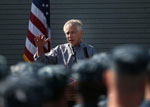
 AFP: Diplomacy with Iran must be backed up by US military might, Pentagon chief Chuck Hagel said Saturday in a speech addressed to Gulf allies anxious over a nuclear deal with Tehran.
By Dan De Luce
MANAMA (AFP) — Diplomacy with Iran must be backed up by US military might, Pentagon chief Chuck Hagel said Saturday in a speech addressed to Gulf allies anxious over a nuclear deal with Tehran.
Hagel promised the United States would maintain a 35,000-strong force in the Gulf region, as well as an armada of ships and warplanes, despite the recent deal with Tehran.
Speaking at a security conference in Bahrain, he said the interim deal with Iran to roll back its nuclear programme was a risk worth taking but that Western diplomacy should not be “misinterpreted.”
“We know diplomacy cannot operate in a vacuum,” he said.
“Our success will continue to hinge on America’s military power, and the credibility of our assurances to our allies and partners in the Middle East.”
The Pentagon “will not make any adjustments to its forces in the region — or to its military planning — as a result of the interim agreement with Iran,” he added.
In a trip meant to reassure Gulf allies wary of America’s diplomatic opening with Iran, Hagel enumerated an array of US weaponry and resources deployed in the region.
“We have a ground, air, and naval presence of more than 35,000 military personnel in and immediately around the Gulf,” he said.
The military footprint includes 10,000 US Army troops with tanks and Apache helicopters, roughly 40 ships at sea including an aircraft carrier battle group, missile defence systems, radar, surveillance drones and warplanes that can strike at short notice, he said.
“Coupled with our unique munitions, no target is beyond our reach,” said Hagel, in an apparent reference to “bunker buster” bombs designed to penetrate deeply buried targets.
A senior US defence official, who spoke on condition of anonymity, told reporters the speech sent a message of solidarity to Gulf allies while also conveying a warning to adversaries “that any sort of mythology of American retreat is just wrong-headed.”
Gulf allies, especially Saudi Arabia, are concerned over a November 24 interim accord between world powers and Iran that offers limited relief from Western sanctions in return for Tehran rolling back elements of its nuclear programme.
The nuclear deal has strained US relations with the mostly Sunni Gulf Arab states that view Shiite Iran as a dangerous rival.
The Iran accord topped the agenda in Hagel’s talks with Gulf counterparts on Friday, which included a meeting with Saudi Arabia’s new deputy defence minister, Prince Salman bin Sultan.
Hagel stressed “the centrality of the defence partnership in maintaining the long-standing ties” between the United States and the Saudi kingdom, officials said.
Hagel said he would travel on to Qatar and Saudi Arabia after the conference for further talks.
“Secretary Hagel will travel to the kingdom of Saudi Arabia on Monday to continue consultations with senior Saudi officials on US-Saudi regional security cooperation,” assistant press secretary Carl Woog said.
Washington’s reluctance to intervene against Syrian President Bashar al-Assad, a staunch ally of Tehran, as well as budget pressures and a US “rebalance” to Asia have added to the doubts among Gulf governments about America’s staying power in the region.
Hagel acknowledged “anxieties” in the Gulf were running high.
“Questions have been raised about America’s intentions, strategy, and commitment to the region,” he said.
But he promised the United States “will remain fully committed to the security of our allies and our partners in the region.”
Although the Pentagon faced the prospect of steep budget cuts, Hagel suggested the big presence in the Middle East would remain a top priority and largely shielded from spending reductions.
In addition to keeping a robust US force in place, Hagel vowed to bolster the military strength of Gulf states, urging regional cooperation on missile defence.
Hagel only briefly mentioned the popular unrest that has swept aside or challenged regimes across the Middle East.
He renewed calls for a “democratic transition” in Egypt and argued for political “reforms” in the region to ensure long-term stability.
But his overriding focus was on defence ties between Washington and the Gulf states, and he argued that the bonds were as strong as ever. As evidence, Hagel cited more than $75 billion worth of US arms sales to Gulf countries since 2007.


