


 Reuters: Senior diplomats from six world powers met in Brussels on Wednesday to fine-tune negotiating strategy towards Iran with talks on its contested nuclear program entering a crunch stretch before a July 20 deadline.
By Justyna Pawlak
BRUSSELS (Reuters) – Senior diplomats from six world powers met in Brussels on Wednesday to fine-tune negotiating strategy towards Iran with talks on its contested nuclear program entering a crunch stretch before a July 20 deadline.
The six – the United States, Russia, China, France, Britain and Germany – and Iran plan in mid-May to start drafting the key elements of a broad settlement to the nuclear dispute, with the hope of putting an end to a decade of tensions that have heightened the risk of a wider Middle East war.
Diplomats have signaled some progress may have been made during three rounds of talks since February on one of the most thorny issues – the future of Iran’s planned Arak heavy-water reactor, which Western states worry could prove a source of plutonium for nuclear bombs once operational.
But talks so far have made no headway on other major issues, with the sides laying out their broad positions rather than negotiating solutions. Western diplomats warn that gaps between the two sides remain significant and possibly insurmountable.
The six nations now must decide what they want to achieve specifically in the next three months to allay their concerns that Iranian nuclear work has underlying military purposes.
Broadly, they want to ensure the program is curtailed enough so that it would take Iran a long time to assemble nuclear bomb components if it chose to do so. The Islamic Republic denies having such intentions.
Iran’s overriding goal in the talks is an end to tough economic sanctions that have hammered its oil-based economy.
U.S. Secretary of State John Kerry has said the current Western assessment of Iran’s capability in this regard is two months, a time frame that is far short of what will likely be acceptable to the powers.
“We need to elaborate our positions … on what ideas will be put forward at the next (negotiation) round,” one diplomat with the six negotiating nations said. “It’s an important meeting because we want to get more concrete.”
Negotiators must decide to what extent they will want Iran to limit the scope of its uranium enrichment capacity, what should happen with its nuclear facilities which Western powers believe have little or no civilian value, as well as the future of Iran’s nuclear research.
A central decision they need to make is the number of centrifuges, which potentially can enrich uranium to bomb-fuel quality, that will be acceptable for them as remaining in Iran. Tehran has about 10,000 of the machines operating but the West will likely demand that the number is cut to the low thousands.
“That’s the billion-dollar-question, one to be decided on July 19 in the evening,” one negotiator said, conceding that getting Iran to agree to cut back the number of the machines will be a crucial challenge.
GETTING DOWN TO DETAILS
The sides are due to meet in Vienna on May 13 and again in late June, before hunkering down for a possibly lengthy round of 11th-hour talks ahead of the July deadline, when an interim deal they struck last November expires.
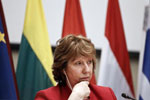
Officials disclosed no details of what decisions, if any, were taken at the Brussels meeting of senior diplomats from the six nations on Wednesday. But a spokeswoman for EU foreign policy chief Catherine Ashton said the talks had been “useful”.
In Iran, senior policy-makers have made a concerted effort to bring on board conservative hardliners who have bristled at the shift to a more moderate foreign policy since President Hassan Rouhani took office in August.
They have repeatedly criticized the interim accord but have been held in check by clerical Supreme Leader Ayatollah Ali Khamenei, the ultimate political authority in Iran.
Ali Larijani, the powerful conservative speaker of parliament, traveled to the Shi’ite Muslim clerical stronghold of Qom on Sunday and met a number of grand ayatollahs who command broad religious followings in an apparent bid to garner their support.
Rouhani, meanwhile, in a riposte to hardliners who suggest he is capitulating to the West, accused critics of his government on Tuesday of using lies and exaggeration to oppose his policies, including Iran’s nuclear talks with world powers.
He suggested his critics were a “tiny minority” who had profited from shortages caused by sanctions and feared losing out if such curbs were removed by the West as part of an eventual resolution of the nuclear dispute.
For the Islamic Republic, the sequence of lifting of Western sanctions, including massive curbs on finance imposed by the United States and the European Union’s embargo on purchases of Iranian oil, will be a vital part of any deal.
(Additional reporting by Mehrdad Balali in Dubai and Fredrik Dahl in Vienna, editing by Mark Heinrich)


