


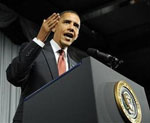
 Bloomberg: Obama administration officials publicly urged Iraq’s leaders yesterday to make their Shiite-dominated government more inclusive as part of a broader strategy to roll back gains by the Sunni militants. The calls were made as Maliki warned that the violence could spill into neighboring countries and as militants attempted to seize a major oil refinery.
Bloomberg
By Margaret Talev, Kathleen Hunter and Caroline Alexander
The U.S. is distancing itself from Iraqi Prime Minister Nouri al-Maliki, pressing for a political change that could help blunt a Sunni insurgency as President Barack Obama weighs possible air strikes against the extremists.
Obama administration officials publicly urged Iraq’s leaders yesterday to make their Shiite-dominated government more inclusive as part of a broader strategy to roll back gains by the Sunni militants. The calls were made as Maliki warned that the violence could spill into neighboring countries and as militants attempted to seize a major oil refinery.
“Not enough has been done by the government, including the prime minister, to govern inclusively and that has contributed to the situation and the crisis that we have today,” White House press secretary Jay Carney said. Asked if Maliki should step down, he declined to voice support, saying, “that’s not, obviously, for us to decide.”
Iraq has asked the U.S. to use air strikes to help defeat the Islamic State in Iraq and the Levant, whose rapid military success has raised the specter of sectarian civil war in OPEC’s second-largest oil producer. The conflict threatens to draw in the U.S. as well as regional powers including Shiite-ruled Iran and Sunni Gulf Arab states.
U.A.E. Envoy
The United Arab Emirates yesterday summoned its envoy in Iraq for consultations and expressed “its deep concern at the continuation of the policy of exclusion, sectarianism and marginalization,” according to the state-run WAM news agency. Saudi Arabia, the region’s biggest Sunni power, also blamed “sectarian policies” for the crisis.
Maliki yesterday said all Iraqis, minority Sunnis and majority Shiites, stand united in the face of terrorism. He warned that fighting could spill into neighboring states and blamed regional countries he didn’t name for providing ISIL with moral and logistical support.
Brent oil for August settlement rose to a nine-month high yesterday, climbing 81 cents, or 0.7 percent, to end the session at $114.26 a barrel on the London-based ICE Futures Europe exchange. It was the highest close since Sept. 6.
Control of a major refinery at Baiji north of Baghdad has swung several times and Kurdish armed forces have clashed with ISIL insurgents. Exxon Mobil Corp. and BP Plc have begun removing employees in Iraq, and Obama notified Congress this week he would deploy as many as 275 troops to protect the U.S. embassy in Baghdad and other diplomatic installations.
Balancing Questions
Obama is balancing questions about the long-term viability of the Maliki government against calls from some Republicans to intervene more aggressively — and from some Democrats to refrain from deepening engagement three years after the U.S. ended its combat mission in Iraq.
The president briefed Democratic and Republican congressional leaders at the White House yesterday on what the administration termed “options for increased security assistance” for Iraq.
“The president said he is not currently considering actions that would require congressional approval but was very clear that he would consult with Congress if that changed,” Senate Majority Leader Harry Reid, a Nevada Democrat, said in a statement after meeting with Obama.
Underscoring the U.S. stance, Vice President Joe Biden yesterday spoke by telephone with Maliki, top Iraqi legislator Osama al-Nujaifi and Kurdistan Region President Massoud Barzani to express U.S. solidarity with Iraq against the militants.
Biden “emphasized the need for the prime minister — and all Iraqi leaders — to govern in an inclusive manner, promote stability and unity among Iraq’s population, and address the legitimate needs of Iraq’s diverse communities,” a White House statement on the calls said.
The Sunni Muslims are a majority in Anbar Province to the west and in areas to the north of Baghdad, mostly areas that lack the oil wealth concentrated in the Shiite-dominated south and the semi-autonomous Kurdish regions in the north.


