


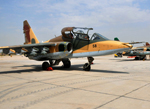
 New York Times: Deepening its involvement in the crisis in Iraq, Iran has sent three Russian-made attack planes to the Maliki government that could be deployed against the Sunni militants who have wreaked havoc on Iraqi military forces. Delivery of the Su-25 aircraft, which American officials said had already conducted missions in western and northern Iraq, is the latest step Iran has taken to help Prime Minister Nuri Kamal al-Maliki.
The New York Times
By Michael R. Gordon and Eric Schmitt
WASHINGTON — Deepening its involvement in the crisis in Iraq, Iran has sent three Russian-made attack planes to the Maliki government that could be deployed against the Sunni militants who have wreaked havoc on Iraqi military forces, American and Iraqi officials said Tuesday.
Delivery of the Su-25 aircraft, which American officials said had already conducted missions in western and northern Iraq, is the latest step Iran has taken to help Prime Minister Nuri Kamal al-Maliki battle the forces of the Islamic State in Iraq and Syria, or ISIS, and expand its influence as Iraqi politicians struggle to form a new government.
An American official, who declined to be identified because he was discussing intelligence reports, said that at least one of the planes had been flown by an Iranian pilot. A senior Iraqi official, however, insisted that the aircraft were being piloted only by Iraqis. He said that the planes originally belonged to the Iraqi Air Force and were flown to Iran during the 1991 Persian Gulf War for safekeeping.
“Iran, understanding the urgency of our situation on the ground, gave us some of our own planes back,” said the Iraqi official, who declined to be named because he was discussing military preparations in Iraq.
The deployment of the Su-25s, which the Iraqi Ministry of Defense showed being loaded with bombs and ammunition, came amid reports that an Iranian officer had recently been killed near Samarra, where Iraqi forces are trying to defend a Shiite shrine against an ISIS attack. Two American officials said that the Iranian, whom the Iranian IRNA news agency identified as Col. Shoja’at Alamdari Mourjani, had been with an Iranian drone unit and was hit by an ISIS mortar attack. The senior Iraqi official insisted, however, that the dead man was an Iranian religious tourist who worked in the aviation industry in Iran.
Iraq’s need for air power is clear. Its air force has consisted of several Cessna planes that carry American-supplied Hellfire missiles and an assortment of American and Russian-supplied helicopters, which the Iraqi military used during its recent fight with ISIS in Tikrit.
The United States has sold Iraq F-16 warplanes, the first of which was to have been sent this fall. But the delivery date is now uncertain since the American contractors who have supported the program were evacuated from the Balad air base during the ISIS offensive. Iraq recently announced that it was also buying Su-25s from Russia, but those aircraft are not yet believed to be in operation. Iran’s provision of the Su-25s follows its decision to send a fleet of Ababil surveillance drones, an intelligence unit to intercept communications and advisers.
Like the Iranian drone and intelligence units, the aircraft are based at the Rasheed air base in Baghdad. Similar to the American A-10 aircraft, the Su-25 is designed for ground attacks. It is equipped with a 30-millimeter cannon and armed with rockets and bombs, and it could be effective against ISIS convoys and concentrations of ISIS fighters, said Joseph Dempsey, a military analyst at the International Institute for Strategic Studies in London.
An American official said that Su-25s had already carried out missions over Ramadi, Falluja in western Iraq and the Baiji refinery in northern Iraq. The official did not say whether the aircraft dropped any bombs but added that Iran had sent more Revolutionary Guards ground forces and air force personnel to Iraq.
Some influential members of the Senate Armed Services Committee on Tuesday voiced concerns about Iran’s growing presence in Iraq after being briefed by Defense Secretary Chuck Hagel and Gen. Martin E. Dempsey, the chairman of the Joint Chiefs of Staff, at a closed meeting of the committee. “They’ve got a heavy involvement at this point,” said Senator Saxby Chambliss of Georgia, who is also the senior Republican on the Intelligence Committee. “I don’t trust the Iranians, so I’m assuming they’re there for mischievous purposes and for their own self-interest.”
The Pentagon press secretary, Rear Adm. John F. Kirby, confirmed on Tuesday that Iran had sent warplanes, weapons, ammunition and military advisers, but so far no combat troops.
“We have no indications that there are Iranian ground troops inside Iraq,” Admiral Kirby told reporters at the Pentagon. “What I’ve said before remains true today: that we know that there are some Iranian operatives — Quds operatives inside Iraq that are training and advising some Iraqi security forces, but more critically, Shia militia.”
“We understand that Iraq, as a sovereign nation, has that right to reach out to a neighbor if they see fit to ask for that support. What we’ve said — and nothing’s changed about what we’ve said — we’re not going to coordinate our military activities with Tehran,” Admiral Kirby said.
Mr. Dempsey, the military analyst based in London, said that at least two Su-25 aircraft in Iraq appeared to be from among the seven Iraqi Su-25s that were flown to Iran during the Persian Gulf War. “The third aircraft, the lone two-seat combat capable trainer, may be drawn from a later Iranian order from Russia,” he said.
Iraqi officials, however, have insisted that all of the Su-25 aircraft were among those that have been kept in Iran, raising expectations that the remaining four Su-25s will also be returned.
The Iraqis’ insistence that all of the planes are Iraqi-owned is significant because Iraq would be violating international sanctions if it bought arms, ammunition or military equipment from Iran, the State Department warned in February. But the Iraqis’ insistence that they alone are operating the planes leaves unclear how the aircraft, which have not been part of the Iraqi military’s inventory for two decades, were flown to Iraq and are currently being maintained.
Mr. Dempsey said that the release of the video of the aircraft by the Iraqi Ministry of Defense might be an attempt “to support the Iraqi narrative of their capacity to operate them independently.”


