


 AFP: Iran’s currency, the rial, hit a record low against the dollar on Wednesday, the ISNA news agency reported, based on rates in blackmarket trading that the government has tried to ban.
By Mohammad Davari
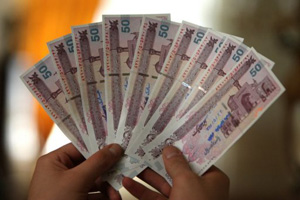 TEHRAN (AFP) — Iran’s currency, the rial, hit a record low against the dollar on Wednesday, the ISNA news agency reported, based on rates in blackmarket trading that the government has tried to ban.
The rial’s plunge, to 18,000 to the dollar, comes ahead of an EU foreign ministers’ meeting next Monday that is expected to add further sanctions against Iran’s economy.
The Tehran government has tried to shore up the value of the rial in recent weeks by imposing a lower rate in banks and currency exchange bureaux, and banning transactions outside of those outlets.
But many exchange bureaux have refused to buy or sell dollars at the imposed rate, and blackmarket dealers have managed to continue to do business despite the presence of police deployed to enforce the ban, according to witnesses in the centre of Tehran.
A website, mesghal.ir, that gives real-time values for the rial against other currencies, quoted a price of 18,200 to the dollar. Access to the site has been blocked on the Internet inside Iran, although people with a VPN (virtual private network) have been able to get around the filter.
The blackmarket figure quoted by ISNA on Wednesday represented a 29 percent difference with the imposed rate of 14,000.
The rial has lost 40 percent of its value against the dollar in the past three months, as the United States and European countries have ramped up their sanctions.
A sudden acceleration in the slide was seen in the first few days of January, after US President Barack Obama signed into law more sanctions hitting Iran’s central bank and targeting foreign companies that do business with Iran.
Economy Minister Shamseddin Hosseini and Central Bank chief Mahmoud Bahmani were summoned before the Iranian parliament on Tuesday over the issue, and promised to bring the exchange rate under control.
The pair “promised the market situation will be managed in a few days” with no difference between the official and blackmarket rates, Deputy Economy Minister Mohsen Salehi-Nia told the Mehr news agency.
Although the government has insisted there is no connection between the rial’s slide and the new sanctions, some officials have admitted a “psychological” effect spooking ordinary Iranians.
A rush to gold and other non-currency assets has been seen. The price of gold coins in Iran has risen 16 percent in the past week, according to ISNA.
The European Union is poised to add to the sanctions by announcing a ban on exports of Iran’s most vital resource, oil, although the embargo is expected to be phased in over a number of months.
US envoys, meanwhile, have been dispatched to several countries that trade significantly with Iran to try to persuade them to financially isolate the Islamic republic.
The currency plunge was happening against a wider backdrop of military threats and covert action against Iran’s nuclear programme.
Western governments fear the programme masks a drive to develop a nuclear weapons capability, an ambition Tehran denies.
Iran has threatened to close the strategic Strait of Hormuz, a narrow channel at the entrance to the Gulf through which 20 percent of the world’s traded oil passes, if new sanctions cripple its economy or if it comes under attack.


