


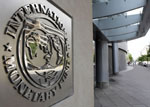
 AFP: The International Monetary Fund said Wednesday that Iran’s economy faces deep structural weaknesses as intensified nuclear sanctions have added to other domestic challenges to the government.
By Paul Handley – 12 hours ago
Washington (AFP)— The International Monetary Fund said Wednesday that Iran’s economy faces deep structural weaknesses as intensified nuclear sanctions have added to other domestic challenges to the government.
But it also said that prospects for the country to return to growth over the coming year have improved with the interim agreement in nuclear talks with global powers — though those prospects “remain highly uncertain”.
In its first review of the Iranian economy in nearly three years, the IMF said that Tehran needs to respond with a “prompt and vigorous” reform program to prevent further deterioration.
A combination of shocks, including the start of subsidy reforms, poorly funded social programs, and the intensification of trade and financial sanctions, had weakened the economy, the IMF said.
“Inflation and unemployment are high, while the corporate and banking sectors show signs of weakness.”
?Iran now stands at a crossroad…. The new authorities should embark on a prompt and vigorous implementation of fundamental reforms to the frameworks supporting product, labor, and credit markets.”
The Fund said the economy continues to shrink, forecasting a contraction of 1-2 percent in fiscal 2013-2014, which ends March 20. The pace of contraction is slowing, though, and inflation has eased from 45 percent in July to less than 30 percent in December.
The IMF said Iran’s authorities are “well aware” of the problems and challenges they face, and have already begun to prepare some of the reforms needed.
The report came following a two-week visit by an IMF “Article IV” economic assessment mission to the country, its first in nearly three years. Such missions are usually carried out on an annual basis.
It also came as the tough international sanctions on the country, aimed at forcing it to pull back on its alleged nuclear weapons program, were slightly loosened in January amid progress in nuclear talks between Tehran and the P5+1 group — the five permanent members of the UN Security Council, and Germany.
The IMF suggested that if the six-month interim agreement with the P5+1 can be built upon, the economy could rebound with growth of 1-2 percent in 2014-2015.
But it stressed the government needs to pursue a complicated, three-pronged austerity strategy to get inflation under control.
The key elements include tightening monetary policy to stall inflation, which the IMF said would not likely hurt overall economic output.
It said the government needs to restrict its deficit to 2-3 percent of gross domestic product, or economic output, balancing the need to help growth without fueling inflation.
And the government needs to continue pursuing the priority of subsidy reform, including increasing domestic energy prices.
The IMF acknowledged the need to cautiously reform subsidies to avoid shocking the economy, and called the government’s gradual approach “prudent”.
In addition, the IMF recommended strengthening the abilities and role of the Iranian central bank so it can better focus monetary policy on stabilizing prices.


