


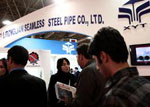
 AFP: As Western corporations headed for the exits when sanctions took effect and international distrust over Iran’s nuclear activities deepened, Summer Lee, an energetic thirty-something from Shanghai, was among those who filled the vacuum.
AFP – The past few years have been good to Chinese companies doing business in Iran, with the oil industry offering the biggest opportunity of all, but things might start getting tougher.
As Western corporations headed for the exits when sanctions took effect and international distrust over Iran’s nuclear activities deepened, Summer Lee, an energetic thirty-something from Shanghai, was among those who filled the vacuum.
At this week’s annual Oil, Gas and Petrochemical Fair in Tehran, a massive event that attracted 600 foreign companies, Lee said she was here to stay.
“We are looking to expand our business deals with Iran,” she said, as delegates shuttled between hundreds of exhibition stands and meeting tables where potential deals were discussed.
But with a possible end in sight to the nuclear standoff that has defined Iran’s thorny relations with the Western world for the past decade, Lee and her countrymen may soon have new rivals.
The issue for some Iranian companies is that Chinese products are not always up to scratch.
– Quality an issue –
“With quality an issue, we expect the market to switch back towards them, rather than us keeping the Chinese,” said Falcon Procurement’s Arash Heiratangiz, which is licensed to import equipment from Germany, Japan and South Korea.
“The Japanese and Europeans can come back if the sanctions are lifted,” he said.
This week’s edition of the fair, where business people and government officials toured a vast array of oil and gas drilling companies and manufacturers, attracted three times as many overseas companies as last year’s event.
Despite the uncertainty that clouds Iran’s economy, which is still shut out of the international financial system because of a US and European embargo on banks and the energy sector, a more positive outlook is starting to prevail.
Behrooz Nateghi, of IPS Group BV, a Dutch purchasing company still operating in Iran’s petrochemical, oil and gas industries, said the lifting of sanctions would change the business outlook.
Attracting “the clients we lost in the past few years” will be the priority, he said.
– Nuclear deal will open market –
Since an interim agreement with the P5+1 group of Britain, China, France, Russia, the United States and Germany came into effect in January, Iran has been allowed to maintain its oil exports at around 1.2 million barrels per day.
The figure remains under par for Iran, which has the world’s second biggest gas deposits and fourth largest oil reserves — 2.5 million bpd of crude was being sent abroad in late 2011.
When asked about the competition from Chinese contractors who moved in after the nuclear dispute made Iran a high risk market for Europeans, a director at a Western company said: “Our quality speaks for itself.”
“We can gain a fair share of the market by approaching our old clients,” added the director, who asked not to be named.
But Lee, of the Leyon International Trading company, a supplier of pipes and tubing to oil and gas ventures, appeared unfazed by the potential upsurge in competition.
If sanctions are removed, “business will be even easier,” she said.
It is not only Iranian companies who are questioning what China has to offer. The government is also dissatisfied.
Oil Minister Bijan Zanganeh last week cancelled a $2.5 billion contract with China National Petroleum Corp (CNPC), citing the company’s failure to fulfill its obligations.
The decision was seen as an invitation to other suitors given the scale of projects such as South Pars, the world’s largest natural gas field shared with Qatar. It has been heavily hit by sanctions, with a lack of financing and technology leading to repeated missed deadlines.
Mike Song, a sales official at South Korea’s RMK Co Ltd, which started supplying pipes, valves and other equipment in Iran 10 years ago, said big opportunities await, if the political obstacles can be removed.
“Business with Iran has been dwindling — practically with no new orders — due to sanctions and pressures,” he said. “We want to make a comeback.”


