


As the protests by nurses, healthcare staff, and emergency personnel continued in at least nine cities—Isfahan, Neyshabur, Bandar Abbas, Kermanshah, Tehran, Bushehr, Hamedan, Yazd, and Ilam—on Tuesday, August 27, government agents clashed with the gathering of medical emergency staff in Bushehr, arresting several of them.
Several nurses and emergency medical staff have been arrested in Bushehr.
The exact number of those arrested remains unknown, and Iranian security officials have not provided any information on the matter.
Security forces were also highly visible during the nurses’ protests in Tehran, attempting to disperse the demonstrators.
However, the protesters insisted on continuing their demonstrations until their demands are met, chanting, “You think it’s just today, but we’re here every day.”
In Hamedan, protesting nurses gathered in front of the governor’s office, chanting, “Enough with the promises, our tables are empty.”
Protest slogans were also repeated during the nurses’ rally in Kermanshah, where demonstrators held placards demanding “Transparent payment of nursing fees” and “Full implementation of the productivity law according to nursing services.”
In Yazd, protesting nurses went on strike at Sadoughi Hospital, staging a sit-in in the hallways and chanting, “Nurses will die, but will not accept humiliation.”
Nurses at the Issa Bin Maryam Hospital in Isfahan chanted, “Overtime pay is 200,000 rials ($0.33), shame, shame.”
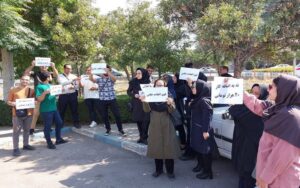
In Bandar Abbas, protesting nurses gathered in front of the Hormozgan governor’s office, chanting, “We don’t want promises, we want our rights,” and “Nurse, shout out, scream for your rights.”
Nurses and medical staff at public hospitals have escalated their protests and strikes in at least 16 provinces of Iran since mid-August, emphasizing the fulfillment of their professional and livelihood demands. According to reports, several protesters have been arrested on charges of being “troublemakers.”
The nurses are protesting against the non-implementation of the tariff law, mandatory overtime, and meager wages, and they insist that the Ministry of Health must listen to their voices and meet their demands.
In recent years, Iranian regime officials have responded to labor protests with similar rhetoric, promising to address the demands, but in practice, some of these promises have been partially fulfilled or not implemented at all.
According to Mohammad Sharifi-Moghaddam, Secretary-General of the House of Nurses, “For the first time in 100 years of modern nursing in Iran, protests have taken the form of work stoppages,” and “The situation has reached a point where nurses don’t care if they get fired for striking.”
According to reports in Iranian media, security and administrative crackdowns on protesting nurses continue, and they are being threatened for pursuing their professional demands. These threats have persisted since the beginning of the Masoud Pezeshkian administration.
In this regard, the state-run Tejarat News website wrote on Monday, August 26: “Instead of working to resolve the issues and meet the demands of the nurses, the officials have resorted to sending letters and making phone calls to threaten the nurses, forcing them to continue working under these substandard and illegal conditions.”
Sharifi-Moghaddam told Tejarat News: “What the nurses are demanding is their legal rights, and they want the law to be properly enforced,” adding, “This inappropriate practice of threats and intimidation not only fails to solve the problems but may also lead to a worsening of the situation.”
He emphasized, “Threatening nurses with wage deductions, when a nurse’s salary in many cities doesn’t even cover their commuting costs to the hospital, is unlikely to bring them back to work.”
Nurses say that their unmarried colleagues with master’s and doctoral degrees earn slightly more than 120 million rials (approximately $200), while the highest salary for a married individual with child allowances and marriage benefits does not even reach 150 million rials (approximately $250).


