


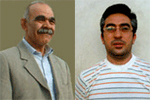
 Iran Focus: London, Jan. 24 – Britain and prominent human rights group Amnesty International on Monday condemned the execution of two prominent Iranian political prisoners.
Iran Focus
London, Jan. 24 – Britain and prominent human rights group Amnesty International on Monday condemned the execution of two prominent Iranian political prisoners.
Jafar Kazemi, 47, and Mohammad Ali Haj-Aghaie, 62, were hanged at dawn for taking part in anti-government protests in 2009 and supporting the main Iranian opposition group People’s Mojahedin Organisation of Iran (PMOI), according to a statement by the Tehran prosecutor’s office. The statement did not state where they were hanged.
“I condemn today’s execution in Iran of Jafar Kazemi and Mohammad Ali Haj-Aghaie. They were arrested during the unrest that followed the 2009 election and I am particularly concerned by reports that they were executed for political offences”, Alistair Burt, UK Foreign Office minister for the Middle East, said in a statement.
“There has been an alarming rise in the number of Iranian executions since the start of the year. More than 60 people have been put to death – more than two every day – and annually Iran executes more people than almost all other countries combined. The use of cruel and inhumane methods such as suspension hanging and public executions is reprehensible. I again call on Iran to cease using the death penalty”, he said.
Malcolm Smart, Amnesty International’s director for the Middle East and North Africa, said: “We are appalled by the executions of Ja’far Kazemi and Mohammad Ali Haj Aghaei, as we are appalled by the continuing use in Iran of this most cruel and extreme penalty”.
“Like so many other victims, neither of these men received a fair trial”, he said. According to some reports, Jafar Kazemi was tortured for months by his interrogators at Evin Prison to force him to make a televised “confession” but he refused to do so, Amnesty said.
A statement by the Tehran prosecutor said that the pair had resorted to “distributing pictures and banners related to the Monafeghin (PMOI), taking photos and films of the clashes as well as chanting slogans in favour of the group”.
The executions were condemned by the National Council of Resistance of Iran, the main opposition coalition which includes the PMOI.
NCRI President-elect Maryam Rajavi called on the world community, the UN Security Council and the European Union to “condemn these barbaric executions and to suspend economic and diplomatic ties with the ruling medieval regime until an improvement in the situation of human rights and a halt in torture and execution”.
US Secretary of State Hillary Clinton last August urged Iran to release the two men.
Both men had previously visited their relatives in Camp Ashraf, Iraq. The camp houses some 3,400 members of the PMOI. Kazemi’s son lives at the camp, which is located some 60km north of Baghdad.
“For months, the residents of Camp Ashraf have been subject to constant harassment, pressure and siege like conditions by the Iraqi authorities, who wish them to leave Iraq. They would be at very serious risk if forced to return to Iran”, Amnesty said.
Lord Corbett of Castle Vale, chairman of the British Parliamentary Committee for Iran Freedom, in a statement said that by executing the pair the regime was violating its own “draconian laws”, adding that the regime “fears Ashraf is seen as a beacon of hope inspiring millions in Iran who cry freedom”.
In December, Ali Saremi, a political prisoner of 24 years, was hanged on charges of visiting his son in Camp Ashraf. Earlier this month, a young Kurdish dissident, Hossein Khezri, met the same fate.


