


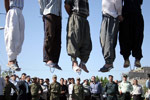
 U.S. Mission in Geneva: While Iran has begun to shift its rhetoric on human rights, the United States remains deeply concerned that Iran continues to suppress free expression and civil society, harass members of its ethnic and religious minority populations, and imprison human rights defenders and journalists for political purposes.
The U.S. Mission in Geneva
Statement delivered to 25th Session of Human Rights Council by Paula Schriefer,
Deputy Assistant Secretary of State for International Organization Affairs
Head of the U.S. Delegation to the 25th Human Rights Council
Geneva – Despite Iran’s change of administration, we have witnessed no significant improvement in Iran’s overall human rights situation. While Iran has begun to shift its rhetoric on human rights, the United States remains deeply concerned that Iran continues to suppress free expression and civil society, harass members of its ethnic and religious minority populations, and imprison human rights defenders and journalists for political purposes.
Iran imprisons the second largest number of journalists in the world today, severely limiting the Iranian people’s access to information and restricting freedom of expression. On February 20, Iran’s judiciary closed the newspaper Aseman for questioning whether “eye-for-eye” justice is humane. This follows similar closures of reformist publications Bahar and Hamihan in November. We are also concerned by reports of the Iranian government’s engagement in the local “downlink” jamming of satellite broadcasts.
Likewise, the plight of Iran’s minority communities remains poor. Ethnic minorities including Kurds, Azeris, Ahwazi Arabs, and Baluch are sentenced to long jail terms and death sentences on trumped-up security-related charges. Iran’s execution of three Kurdish activists in October and November was deeply troubling, as was the execution in January of two Ahwazi Arab cultural activists for vague security-related charges. Religious minorities, from non-Shia Muslims to Baha’is, are subject to similar harsh treatment simply for practicing their religious beliefs. We take this opportunity to call once again for the release of dual U.S.-Iranian citizen Saeed Abedini, who is currently being held in Iran on charges related to his religious beliefs.
The United States also remains concerned by the situation of political prisoners in Iran. While Iran’s recent release of dozens of prisoners of conscience—including human rights lawyer Nasrin Sotoudeh—was encouraging, hundreds more remain in detention. Human rights defenders and activists like Abdolfattah Soltani, Majid Dorri, Majid Tavakkoli, and Shiva Nazar Ahari should be immediately released.
Finally, we also regret that despite Iran’s egregious human rights situation, its government persists in refusing to cooperate with the Special Rapporteur. Consistent with Iran’s welcome efforts to constructively engage with the international community in other areas, the United States calls on the Iranian government to allow the Rapporteur to visit Iran so that he may carry out the Human Rights Council’s mandate. And we call upon this Council to renew that mandate this session.
Dr. Shaheed, given the lack of improvement in Iran’s overall human rights situation in the last year, what more can the international community do to persuade the Iranian government to respect the human rights of its people?


