


Iran Focus
London, 2 August – Mrs. Maryam Rajavi, the President-elect of the National Council of Resistance of Iran (NCRI), paid tribute to the tens of thousands of political prisoners that lost their lives during the 1988 massacre.
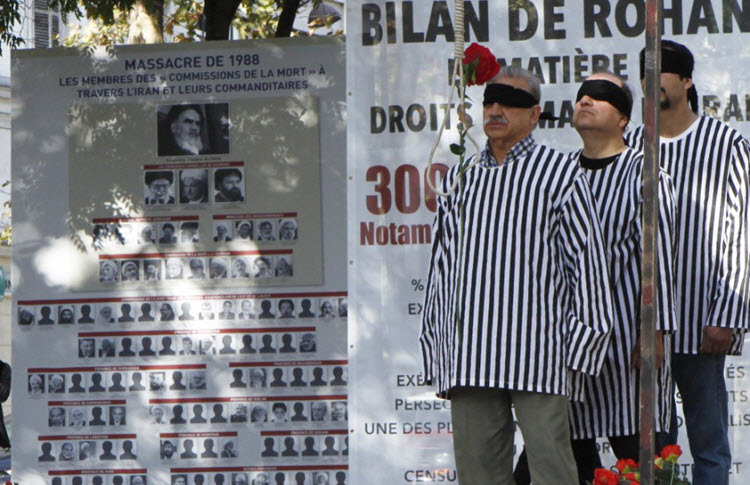
During the summer of 1988, on the orders of the Supreme Leader at that time – Ruhollah Khomeini – a special commission was set up to execute members of opposition group People’s Mojahedin Organization of Iran (PMOI).
The members of the special commission, often referred to as the “death committee”, ordered the execution of all the opposition members they came up against. The prisoners were “tried” and the death commission decided their fate. If there was any link to the PMOI, no matter how far removed, the prisoner would be executed.
Mrs. Rajavi, in a message to mark the 30th anniversary of the massacre, said that the PMOI members and other freedom-loving activists died so that “the Iranian nation could be proud in one of the darkest eras of her history”. She said that Khomeini’s desire to get rid of all traces of opposition failed. The people were never forgotten and the opposition has not been silenced.
In fact, she notes that the opposite has happened. The people want their voices to be heard more than ever, and at the end of last year people from all over the country participated in the biggest uprising in the country’s recent history.
The 1988 massacre has gone unpunished even though much has been said about it in recent months. In 2016, an audio recording of heir-designate to Ayatollah Khomeini as the country’s Supreme Leader, Grand Ayatollah Hossein-Ali Montazeri, was released. He was heard speaking to other members of the death commission condemning the mass executions. He said that the events would go down as some of the worst in history.
It is shocking that officials that played a role in this crime against humanity have gone on to hold important roles in the ruling system. For example, Mostafa Pourmohammadi who was on the death commission recently served as the country’s Minister of Justice. Another member, Ebrahim Raisi, a presidential candidate, went on to serve as an Attorney-General and Vice Chief Justice of Iran.
Mrs. Rajavi pointed out that the renewed calls for justice are challenging the regime “in its entirety” and that the mullahs “continue to struggle to remove the traces of their crimes”. She said that graves are being razed across the country as officials try to distance themselves from the massacre.
Mrs. Rajavi also made a call for action: “Once again, I urge my fellow compatriots and all freedom loving people to actively participate in the Call-for-Justice movement for victims of the 1988 massacre. This is the movement of the oppressed. This is the voice of the oppressed. Everyone who has experienced imprisonment and detention, anyone who has been flogged, any woman who has been assaulted and humiliated, and every grieving soul, is a member of this movement. Demanding justice for victims of the 1988 massacre is today part of the movement for the overthrow of the clerical regime.”


