


Amirhossein Moradi and Ali Younesi, students imprisoned in Evin and Ghezel Hesar prisons, wrote notes on the eve of Student Day in which they referred to executions, poverty, and the dictatorship ruling Iran’s regime, emphasizing the necessity of “breaking the silence, the young generation’s struggle for freedom, and the role of the university as the beating heart of protest against tyranny.”
They wrote in these notes, published on Friday, December 5, that December 7 is “a symbol of the covenant between generations standing against despotism” and a sign of the continuation of the “struggle for freedom,” adding that the university, despite repression and imprisonment, remains “the beating heart of this path and the source of hope for the spring of freedom” in Iran.
Iran’s Regime Extends Prison Sentence of Two Elite Students Under New Made-Up Charges
Remembering fellow students
Moradi opened his note by remembering fellow students Ehsan Faridi and Ahmad Baledi, and described the fate of these two students as a symbol of the continued repression of the student movement—from the risk of execution faced by Faridi to the death of Baledi, who set himself on fire in protest against economic pressure and the destruction of his family’s workplace.
He recalled that seventy-two years have passed since December 7, 1953, and wrote of an “execution-driven government” that continues targeting students and, in the face of economic, social, and environmental crises, has resorted to “increasing and massacre-like executions.”
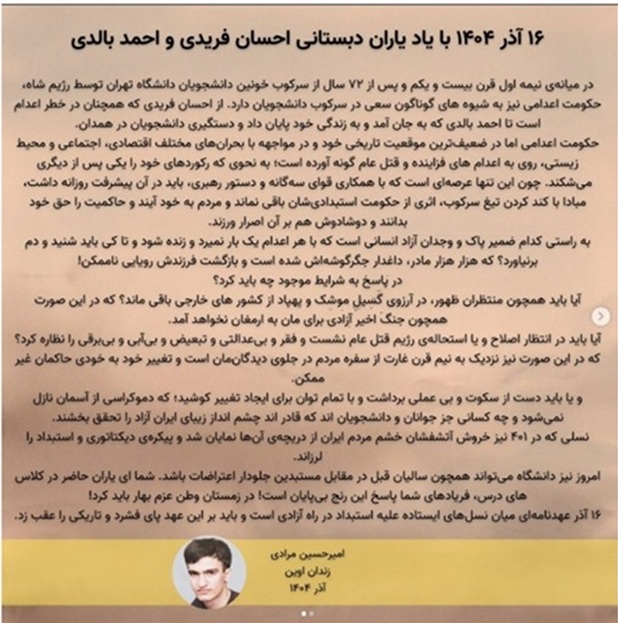
In his view, the cooperation of the three branches of power and the implementation of orders from the leader of Iran’s regime have cemented this cycle of repression.
Moradi listed three paths before society: waiting for foreign intervention, hoping for reform or transformation of the government, and breaking the silence and inaction.
He considered the first two paths dead ends and stressed that “democracy does not descend from the sky,” and the only way forward is collective effort for change—a task whose main burden rests on young people and students.
Referring to the role of universities in the 2022 nationwide uprising, he called the university the primary capacity for confronting tyranny and addressed students: “Your cries are the answer to this endless suffering! In the winter of the homeland, one must resolve for spring! December 5 is a pact between generations standing against despotism on the path to freedom, and we must uphold this pact and push back the darkness.”
The struggle for freedom
Younesi began his note with the image of the beginning of winter and a calendar leaving autumn behind, writing that although “it is supposed to be always winter” behind prison bars, this winter does not necessarily mean despair.
Having been kept away from university and his scientific dreams for more than two thousand days due to imprisonment, he wrote that during this time he has looked to “the lessons of prison and its resilient prisoners.”
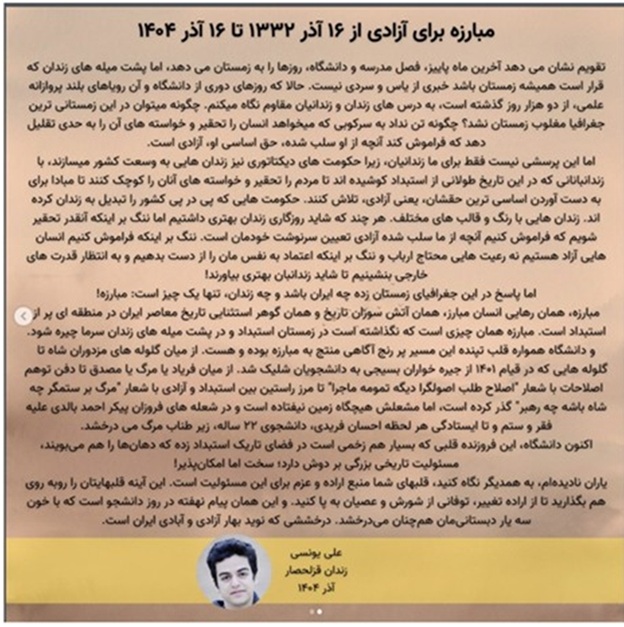
The imprisoned student asked how one can avoid succumbing to the cold in “the most wintry geography,” stressing that this question is not only for prisoners, because dictatorships build “prisons as vast as the country.”
He warned that forgetting freedom and pinning hopes on foreign powers to bring a “better jailer” is a form of “humiliation of human will.”
Younesi wrote: “Struggle is the very liberation of the fighting human, the burning fire of history, and the exceptional jewel of Iran’s contemporary history in a region full of tyranny. Struggle is what has prevented the cold from taking over in the winter of despotism and behind prison bars.”
He described the university as “the beating heart of the arduous path of awareness that leads to struggle” and wrote: “The torch of this path still shines in Baledi’s burned body in protest to poverty and oppression and in Faridi’s steadfastness under the noose of death.”
Addressing his “unseen friends” at the university, the imprisoned student wrote that their hearts are the source of the will for this historic responsibility, urging them to place “these mirrors” before one another so that from the will to change, “a storm of revolt and defiance” may rise—a message that, he said, has continued to shine since Student Day and the blood of “the three elementary school friends,” promising “the spring of freedom and the flourishing of Iran.”
Younesi, winner of the gold medal in the 2018 International Astronomy and Astrophysics Olympiad, and Moradi, winner of the silver medal in Iran’s 2017 Astronomy Olympiad, are both students of Sharif University of Technology—one of Iran’s leading technical universities.
They were arrested in 2020 at the age of nineteen and about two years later were each sentenced by a Revolutionary Court to sixteen years in prison; the portion of their enforceable sentence was reduced in March 2025 to six years and eight months.
However, the judiciary opened new cases against them, and on August 9, Branch 29 of the Revolutionary Court sentenced the two students to fifteen months in prison on the charge of “propaganda activities against the system.” In a separate case, Younesi was also sentenced to five years in prison in Kerman on the charge of “endorsing and strengthening Israel.”


