


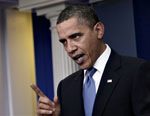
 New York Times: President Obama’s decision to engage in a lengthy battle to defeat the Islamic State in Iraq and Syria reorders the global priorities of his final years in office. The mystery is whether it will deprive him of the legacy he had once hoped would define his second term, or enhance it instead.
The New York Times
By David E. Sanger
WASHINGTON — President Obama’s decision to engage in a lengthy battle to defeat the Islamic State in Iraq and Syria reorders the global priorities of his final years in office. The mystery is whether it will deprive him of the legacy he had once hoped would define his second term, or enhance it instead.
Until now, Mr. Obama’s No. 1 priority in the Middle East has been clear: preventing Iran from obtaining a nuclear weapon.
Israeli officials, who by happenstance arrived in Washington this week for their regular “strategic dialogue,” immediately argued that ISIS was a distraction from that priority. Their fear is that the Iranians, finding themselves on the same side of the fight against ISIS as the United States, would use it as leverage to extract concessions from the president.
“ISIL is a five-year problem,” Yuval Steinitz, Israel’s strategic affairs minister, said a few hours before Mr. Obama addressed the nation on Wednesday night, using the acronym the Obama administration employs to describe the Sunni extremist group. “A nuclear Iran is a 50-year problem,” he said, “with far greater impact.”
Other Israeli officials warned the Obama administration that the new American operation would bolster Iran’s ambitions for regional dominance.
Mr. Steinitz may prove to be right. The Bush administration’s decision to invade Iraq 11 years ago distracted it from many things — notably the war in Afghanistan — and Iran used that time to vastly expand its capacity to produce nuclear fuel. But there is a countertheory as well: that a president who for five years made clear that he was looking for a way out of the bog of the Middle East may have a chance to re-establish American credibility in the region if the strategy he described on Wednesday night is well executed.
“If this goes well, and the United States is seen as acting effectively, it could generate political capital,” said Richard N. Haass, who served in the administration of the first President George Bush — the coalition-builder Mr. Obama says he most admires — as well as that of George W. Bush. “There’s the chance it will be something of an investment in the region. But that is going to require constant rudder checks, to make sure the administration’s broader goals do not go off course.”
It is the fear of veering off course that most haunts Mr. Obama’s current and former top national security aides. Even before the rise of ISIS, they looked at the calendar and worried.
Mr. Obama once saw the reorientation of American focus to the Pacific as his greatest long-term contribution to “rebalancing” American priorities. Tom Donilon, a former national security adviser to Mr. Obama, often described it this way: “We inherited a world in which we were overinvested in the Middle East and underinvested in Asia.”
In setting out to conduct the rebalancing, Mr. Obama argued that America’s long-term economic interests and prosperity lie in how it manages China’s rise. By implication, the Middle East was an economic drag and a military sinkhole.
Yet over the past year, there has been a broad sense that the effort has stalled, along with several others. And in his speech on Wednesday, Mr. Obama said nothing about the opportunity cost of his strategy: How would he ensure that 60 percent of America’s military might is in the Pacific — the goal the Pentagon has laid out — while ramping up the fight in Iraq and Syria? How would he square that with the commitment he made just a week ago to bolster NATO in Eastern Europe, part of another long-term effort, to contain Vladimir V. Putin’s Russia? Or his desire to focus the world on longer-term threats like global warming and cyberattacks?
So far, Mr. Obama’s national security team has suggested that the efforts are not mutually exclusive. They note that the Pentagon has maintained a counterterrorism program in Yemen and Somalia, the two efforts Mr. Obama compared to the operation against ISIS, while the C.I.A. has run a larger operation, under covert-action authorities, against Al Qaeda and the Pakistani Taliban inside Pakistan.
But the goal of degrading and ultimately destroying ISIS requires an effort of a different scale. It goes beyond the “light footprint” strategy that the president used in his first term, which included hundreds of drone attacks against targets in Pakistan and Yemen, a cyberattack on Iran’s nuclear facilities, and the use of special forces against pirates, terrorist cells and Osama bin Laden.
Mr. Obama on Wednesday described a far more sustained effort, in which building and sustaining a coalition, and training Arab forces at a new base in Saudi Arabia, will take time and constant attention.
For the Chinese, this is most likely good news. One recently retired Chinese general noted during the Iraq war that America always seems to let the urgent blowups in the Middle East distract it from the slow, grinding shifts of power in Asia. Unless Mr. Obama backs away from his commitment to shrink the Pentagon budget, it is hard to understand how the United States will be able to do all he would like to do.
How this will affect Iran is a far more complex question.
Mr. Obama never mentioned Iran in his speech. But it has been a frequent subject of conversation inside the Situation Room and at the off-the-record previews of his strategy that Mr. Obama has held for a stream of foreign policy experts and journalists. The new effort, senior administration officials say, certainly puts them on the same side of the fight as the Iranians, who reportedly have put their elite Quds Force on the ground.
“We don’t plan to be Iran’s air force in this battle, any more than we plan to be Assad’s air force,” one senior official said on Wednesday, referring to President Bashar al-Assad of Syria.
But the Iranians are already testing whether America’s newest imperative will give it maneuvering room in the negotiations over its nuclear program. With a reported new energy and trade deal, Iran is trying to split Russia away from the coalition of six powers that are negotiating with Tehran.
The Iranians have missed deadlines to turn over material about suspected military dimensions of their program to the International Atomic Energy Agency. And Iran’s leaders have made clear that they do not plan to give ground on the main issue that is supposed to be resolved by a Nov. 24 deadline: the fate of Iran’s ability to enrich uranium.
“The Iranians may well think we need them to help defeat ISIS and that this will make us more accommodating in the nuclear negotiations,” said Robert Einhorn of the Brookings Institution, who had responsibility for enforcing sanctions. “If they do think that, it is an illusion.”
The administration so far is trying to keep the issues compartmentalized. It says it is “communicating” with Iran about ISIS, but not coordinating action. There is a “commonality of interest” in defeating Sunni extremists, one administration official said, that should give Tehran and Washington a mutual cause.
But the dance required in confronting Iran’s nuclear ambitions and taking the same side in a regional battle is complex, just part of a foreign policy agenda for Mr. Obama’s last 28 months in office that looks little like the one he had imagined.


