


 Reuters: The United States will take unilateral action when needed to deal with the threat to American troops in Iraq from Shi’ite militias armed by Iran, U.S. Secretary of Defense Leon Panetta said on Monday.
By Phil Stewart
 BAGHDAD (Reuters) – The United States will take unilateral action when needed to deal with the threat to American troops in Iraq from Shi’ite militias armed by Iran, U.S. Secretary of Defense Leon Panetta said on Monday.
U.S. forces officially ended combat operations in Iraq last August but have come under increasing fire in recent weeks. Fourteen U.S. service members were killed in hostile incidents in June, the highest monthly toll in three years.
U.S. officials blame Shi’ite militias armed by Iraq’s Shi’ite neighbor Iran for most of the recent attacks.
At least three U.S. service members have been killed this month, including one on Sunday, the day Panetta arrived in Baghdad on his first trip to Iraq as defense secretary.
Washington still has about 46,000 troops in Iraq more than eight years after the 2003 invasion overthrew Sunni dictator Saddam Hussein but is scheduled to withdraw its forces by year-end under a security pact between the two countries.
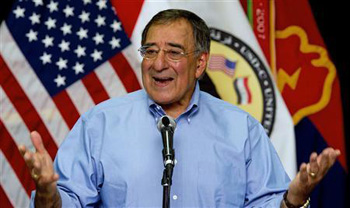
“We are very concerned about Iran and the weapons they are providing to extremists here in Iraq,” Panetta said in an address to U.S. troops in Baghdad. “In June we lost a hell of a lot of Americans as a result of those attacks. And we cannot just simply stand back and allow this to continue to happen …”
Panetta said Washington’s first effort would be to press Iraq to go after Shi’ite groups responsible for the attacks. He was scheduled to meet Shi’ite Prime Minister Nuri al-Maliki later on Monday.
“Secondly, to do what we have to do unilaterally, to be able to go after those threats as well, and we’re doing that,” he said, referring to the right of U.S. forces to defend themselves on Iraqi soil.
General Lloyd Austin, the commander of U.S. forces in Iraq, declined to comment on what specific measures unilateral action might involve.
“I think what the secretary was pointing to was we’ll do what’s necessary to protect ourselves and that could include a host of things … so we’ll just leave it at that,” Austin said.
LETHAL INSURGENCY
U.S. forces in Iraq now operate largely in the background, training and assisting Iraqi police and soldiers against a weakened but still lethal insurgency that launches hundreds of attacks each month.
Hours after Panetta’s arrival, militants fired three Katyusha rockets into Baghdad’s heavily fortified Green Zone, home to the massive U.S. embassy complex and Iraqi government buildings, according to an Iraqi Interior Ministry source.
U.S. officials including Panetta have been pressing Baghdad to decide whether it wants U.S. forces to stay beyond the year-end deadline. Maliki has said he will abide by a decision of the majority of Iraq’s political leaders.
Panetta, who as CIA director helped oversee the covert raid that killed Osama bin Laden, said his number one priority since becoming defense secretary was to defeat al Qaeda. He told Congress last month there were still 1,000 al Qaeda fighters in Iraq.
In language reminiscent of the Bush era, he appeared to link the Iraq war to the September 11, 2001 attacks in his comments to troops.
“The reason you guys are here is because on 9/11 the United States got attacked, and 3,000 … innocent human beings got killed because of al Qaeda,” Panetta said. “And we’ve been fighting them as a result.”
He clarified to reporters he was not talking about the justification for the invasion — intelligence, later proven wrong, that Saddam Hussein had weapons of mass destruction.
Instead, he said it was the fact that in the years since al Qaeda had “really developed a presence here.”
(Reporting by Phil Stewart; Writing by Jim Loney; Editing by Matthew Jones)


