


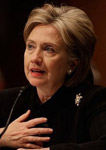
 AP: Iran should not misread the withdrawal of American troops from Iraq as affecting the U.S. commitment to the fledgling democracy, Secretary of State Hillary Rodham Clinton said Sunday.
The Associated Press
WASHINGTON (AP) — Iran should not misread the withdrawal of American troops from Iraq as affecting the U.S. commitment to the fledgling democracy, Secretary of State Hillary Rodham Clinton said Sunday.
President Barack Obama’s announcement Friday that all American troops would return from Iraq by the end of the year will close a chapter on U.S.-Iraq relations that began in 2003 with the U.S.-led invasion to overthrow Saddam Hussein.
Washington has long worried that meddling by Iran, a Shiite Muslim theocracy, could inflame tensions between Iraq’s Shiite-led government and its minority Sunnis, setting off a chain reaction of violence and disputes across the Mideast.
Clinton said in a series of news show interviews that the U.S. would continue its training mission with Iraq and that it would resemble operations in Colombia and elsewhere. While the U.S. will not have combat troops in Iraq, she said the American presence would remain strong because of its bases in the region.
“Iran would be badly miscalculating if they did not look at the entire region and all of our presence in many countries in the region, both in bases, in training, with NATO allies, like Turkey,” she told CNN’s “State of the Union.”
Asked on NBC’s “Meet the Press” about fears of civil war in Iraq after U.S. troops leave, Clinton said, “Well, let’s find out. … We know that the violence is not going to automatically end.”
She added: “No one should miscalculate America’s resolve and commitment to helping support the Iraqi democracy. We have paid too high a price to give the Iraqis this chance. And I hope that Iran and no one else miscalculates that.”
In an interview released Saturday, Iranian President Mahmoud Ahmadinejad said Tehran has “a very good relationship” with Iraq’s government, and said the relationship will continue to grow.
“We have deepened our ties day by day,” Ahmadinejad said in the interview, broadcast Saturday on CNN.
The timeline for U.S. troop withdrawals had been agreed to by President George W. Bush and Iraqi leaders. Obama had campaigned for the presidency with the promise to end America’s war in Iraq.
For months the Obama administration negotiated with Prime Minister Nouri al-Maliki and other Iraqi officials to extend the stay of troops and to build permanent bases. Both sides saw advantages to keeping several thousand U.S. troops in Iraq as part of a training mission, but there was also strong opposition in the U.S. and Iraq for the American troops to stay.
A sticking point was the U.S. demand that American troops be granted legal immunity to shield them from Iraqi prosecution, a flashpoint for Iraqi anger over the Americans’ special status in their homeland.
In Iraq, cheers and fears greeted Obama’s announcement as the country pondered another period of uncertain transition. While many celebrated what they viewed as the end of a foreign occupation, there was also apprehension over what would happen without U.S. troops on hand to help control political and social divisions that still spark shootings and bombings.
Arizona Sen. John McCain, the top Republican on the Senate Armed Services Committee, called the withdrawal decision “a serious mistake” that is viewed in the region as a victory for Iran. He also said the presence of U.S. bases elsewhere in the region will have little impact on Iraq.
“There was never really serious negotiations between the administration and the Iraqis,” McCain told “This Week” on ABC. “I believe we could have negotiated an agreement. And I’m very, very concerned about increased Iranian influence in Iraq.”
Sen. Lindsey Graham, who also serves on the committee, criticized Obama for “not being able to close the deal” with Iraq, and he said the Iranians remain emboldened with “a shot in Iraq they would never had otherwise.” He also expressed concern over Iran’s nuclear program.
“The Iranians don’t fear us at all,” Graham said on “Fox News Sunday.” He added: “At a time when we need troops in Iraq to secure the place against intervention by Iran and the bad actors in the region, we are going into 2012 with none. It was his job, the Obama administration’s job, to end this well. They failed.”


