


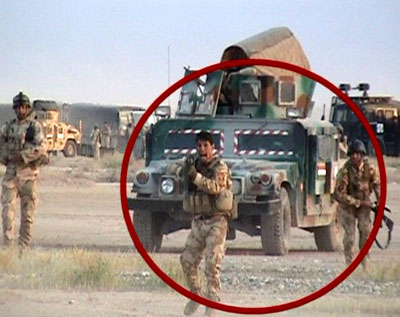
 UPI: If Iraqi troops enter Ashraf as they did in 2011 and 2009, many innocent civilians are sure to die. In the two previous raids, Iraqi armored cars crushed unarmed civilians. Others were shot, 50 died, hundreds were injured.
United Press International
 Iran’s spiritual leader Ali Khamenei has given his orders to the Iraqi government: Camp Ashraf, near Baghdad, must be “invaded.”
By DAVID AMESS, UPI Outside View Commentator
LONDON, Aug. 9 (UPI) — Iranian Supreme Leader Ali Khamenei demands the closure of Camp Ashraf from the Iraqi government. The 1,200 men and women who still call Ashraf home would be dislodged at all costs, with violence if necessary. Iraqi Prime Minister Nouri al-Maliki, a stooge of the clerical regime, is determined to do this unless the international community stands up.
If Iraqi troops enter Ashraf as they did in 2011 and 2009, many innocent civilians are sure to die. In the two previous raids, Iraqi armored cars crushed unarmed civilians. Others were shot, 50 died, hundreds were injured.
While the video of the attacks shocked the world, no one in Iraq was ever held responsible. The troops acted with impunity and no doubt believe they can pull it off again.
Sadly, it seems the United Nations itself has given the green light for this new massacre. Martin Kobler, the United Nations’ special envoy to Iraq stated in his report to the U.N. Security Council last month that the remaining 1,200 residents of Ashraf had no excuse for not joining the 2,000 who had already been transferred to Camp Liberty, a former U.S. military base near Baghdad.
Faleh Fayaz, Maliki’s national security adviser, picked up immediately on the United Nations’ green light. Fayaz has been telling international media that Iraq will “force out the Iran dissident group.”
It was only as a result of a campaign orchestrated by the Iranian resistance leader Maryam Rajavi and their supporters around the world that the Ashraf residents were not massacred entirely by Maliki and his thugs at the end of last year.
The outrage of the international community obliged the Iraqi government to pay heed to an alternative plan entailing the transfer of all residents to the ironically named Camp Liberty, where they could be held in prison-like conditions. This only became evident, however, after the first convoys of residents were transferred.
According to the plan the residents had been sold — by the United Nations’ Iraq envoy, Martin Kobler — Camp Liberty would meet basic humanitarian standards. Many therefore transferred voluntarily as a step to a permanent solution to their refugee status and new lives outside the country.
But upon arrival in Liberty they found it essentially a concentration camp. The tiny area allocated for their living quarters is surrounded by high walls and has no mains water supply.
Camp guards, including those responsible for the previous massacres, not only patrol the perimeter but wander freely within the camp itself.
Those who abandoned Camp Ashraf, in some cases after living there for more than two decades, face losing all their property and belongings to an Iraqi government confiscation plan, despite promises by Kobler and the United Nations to oversee an orderly sale process.
Legal representation has been denied to those living in both camps. Outside visitors of all types, from media to mechanics, are denied access.
In a meeting at the U.S. Congress on Aug. 1, several Congressmen addressed the poor conditions at the camps. U.S. Rep. Dana Rohrabacher, R-Calif., who decried the situation as “disgraceful,” while pointing to a large photograph depicting rows of white structures at Liberty said: “Doesn’t that look like Auschwitz?”
As the U.S. lawmakers underscored, the United States is implicated in the plight of the residents because the U.S. Army promised to protect them when Iraq was liberated from Saddam Hussein. Washington also pledged to ensure the Iraq government treated the Ashraf residents as refugees and not as prisoners — a pledge that seems to have been conveniently forgotten.
The rest of the world is now implicated, too.
Friends of the Ashrafians from Egypt, Iraq, Tunisia, Syria, Jordan, Lebanon, Kuwait, Palestine, Bahrain and Yemen met in Paris on Aug. 4 to warn the international community of the impending Ashraf massacre.
It was an initiative of the Arabic-Islamic Committee in Defense of Ashraf Residents, chaired by Sid Ahmed Ghozali, the former prime minister of Algeria. Prominent activists from across the Islamic world attended.
The event was timely because of the imminent changes in Syria. If the Assad’s regime falls, Tehran will be left increasingly isolated and friendless. The mullahs’ attempts to export their own brand of Islamic fundamentalism will have been dealt a decisive blow.
The mullahs know this and are therefore keen to wipe out their main opposition before it is too late.
We, the international community, should not allow this to happen, for the sake of humanity and for our own sake.


