


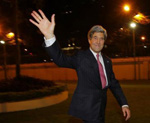
 AP: Confronting the threat of civil war in Iraq, U.S. Secretary of State John Kerry flew to Baghdad on Monday to personally urge the Shiite-led government to give more power to political opponents before a Sunni insurgency seizes more control across the country and sweeps away hopes for lasting peace.
The Associated Press
BAGHDAD (AP)— Confronting the threat of civil war in Iraq, U.S. Secretary of State John Kerry flew to Baghdad on Monday to personally urge the Shiite-led government to give more power to political opponents before a Sunni insurgency seizes more control across the country and sweeps away hopes for lasting peace.
The meeting scheduled between Kerry and Iraqi Prime Minister Nouri al-Maliki was not expected to be friendly, given that officials in Washington have floated suggestions that the Iraqi premier should resign as a necessary first step toward quelling the vicious uprising. Nor will it likely bring any immediate, tangible results, as al-Maliki has shown no sign of leaving and Iraqi officials have long listened to — but ultimately ignored — U.S. advice to avoid appearing controlled by the decade-old specter of an American occupation in Baghdad.
Still, having suffered together through more than eight years of war — which killed nearly 4,500 American troops and more than 100,000 Iraqis — the two wary allies are unwilling to turn away from the very real prospect of the Mideast nation falling into a fresh bout of sectarian strife.
“This is a critical moment where, together, we must urge Iraq’s leaders to rise above sectarian motivations and form a government that is united in its determination to meet the needs and speak to the demands of all of their people,” Kerry said a day earlier in Cairo. He was there in part to meet with Egyptian President Abdel-Fattah el-Sissi to and discuss a regional solution to end the bloodshed by the insurgent Islamic State of Iraq and the Levant, or ISIL.
“No country is safe from that kind of spread of terror, and none of us can afford to leave that entity with a safe haven which would become a base for terror against anyone and all, not only in the region but outside of the region as well,” Kerry said in Cairo.
Even before U.S. troops left Iraq for good at the end of 2011, a merciless Sunni insurgency was pounding the country with car bombs, roadside explosions, suicide bombings and drive-by assassinations, mainly targeting the Shiite government, its security forces and Shiite pilgrims. Since the start of this year, and peaking this month, ISIL has overtaken several cities in Iraq’s west and north, and over the past weekend was controlling several main border crossings between Iraq and Syria.
The three-year civil war in Syria — where Sunni rebels are fighting to overthrow President Bashar Assad, whose Alawite sect is an offshoot of Shiism — emboldened Iraqi insurgents who regularly traverse the porous border to gain recruits, funding and weapons, and battlefield confidence. Years of political instability in Baghdad fueled anger against the Shiite-led government from Sunnis who felt powerless and saw their leaders targeted by al-Maliki’s security forces.
A senior State Department official said the insurgents’ recent march on Baghdad has been slowed, although concerns remain that ISIL will attack the golden-domed Shiite shrine to the Imam al-Askari in Samarra. That city, in Sunni territory in north-central Iraq, was the site of a 2006 bombing that triggered the worst of the war’s sectarian fighting. Last week, Senate Majority Leader Harry Reid declared that Iraq is currently in a civil war.
The official said Kerry on Monday will not ask al-Maliki to resign, as some in the U.S. and Sunni Arab states in Mideast have demanded, because “it’s not up to us.” However, Kerry is expected to urge al-Maliki to quickly create a new government that is far more sensitive to Sunni and Kurdish demands for jobs, power and a fair legal system.
Currently, Baghdad is operating under a lame-duck government, as a new parliament that was elected in April has not yet selected its Cabinet ministers. It took more than nine months to seat a new government the last time Iraq underwent the process, in 2010. This time around, the State Department official said, al-Maliki and other Iraqi officials cannot risk exacerbating the political instability, and further inflaming the insurgency, by stalling a new and more inclusive government.
Both President Barack Obama and Iraq’s top Shiite cleric, Grand Ayatollah Ali al-Sistani, also have urged al-Maliki to quickly form an inclusive government that promotes the interests of all of Iraq’s ethnic and religious groups.
The State Department official briefed reporters on condition of anonymity because he was not authorized to be named in discussing the negotiations. He described al-Maliki and other Iraqi officials as anxious about what, if any, additional help the U.S. might provide to help curb ISIL after Obama this week said he would send about 300 special forces troops to Baghdad to advise and train local security forces.
Obama did not rule out the possibility of also launching airstrikes against the insurgents, but that is not expected anytime soon, if ever, and he has adamantly said he will not send combat forces back to Iraq.
Kerry is scheduled to meet first with al-Maliki in Baghdad’s fortified Green Zone, which houses the prime minister’s office and parliament building as well as the U.S. Embassy. He then will talk to the influential Shiite cleric Ammar al-Hakim, who heads a leading rival Shiite political party; Parliament Speaker Osama al-Nujaifi, one of Iraq’s highest-ranking Sunnis; and Foreign Minister Hoshyar Zebari, a Kurd.


