


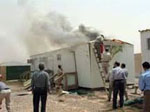
 The Hill: Dissemination of bogus reports of Iranian dissidents’ involvement in attacks against Iraqis is Tehran’s way to justify assaults. The regime’s Qods Force disseminated false reports alleging collusion between the dissidents and the Islamic State of Iraq and Syria (ISIS), to justify attacking the dissidents in their residences at Camp Liberty, Iraq.
The Hill
By Raymond Tanter
Consider the strategic value of Iranian dissidents in Iraq, current preparations and prior attacks by Iranian regime proxies, and responsibility to protect.
For Tehran, Iranian dissidents in Camp Liberty, Iraq are of strategic import. Despite the regime’s charm offensive, talks on its nuclear file are likely to deadlock. And even if negotiations resume after a pause, military options are bound to become front page news again. The dissidents have extensive contacts on the ground in Iran and are potential strategic assets for Washington and its allies against Tehran. The dissidents have historic ties in the area that can help tilt the balance against radical Sunnis and counter an extremist “Shiite arc” of Tehran and its counterpart in Damascus.
Iran seeks to demoralize the dissidents in Iraq so they abandon their cause, repatriate them to Iran, and destroy them as the only organization that challenges clerical rule in Tehran. Moderate Sunni Arab Kingdoms like Jordan and Saudi Arabia are quietly sympathetic to the dissidents because they help counter the threat from radical Iran.
Because of their strategic import, during June 2009 demonstrations in Iran in which colleagues of the dissidents participated, Iraqi forces acting on behalf of Tehran attacked the dissidents in Camp Ashraf, Iraq on July 30. Iraqis raided the Camp, killed 11, held 36 as hostages, and then released them in October.
When unrest recurred in Iran during February 2011, Baghdad again ordered an attack to be launched against dissidents in Ashraf on April 8. There is video evidence of Iraqi forces directly aiming and firing at Camp residents.
On September 1, 2013, there was an attack on Ashraf that killed 52 residents, and assailants seized 7 as hostages. The UN stated, “The missing persons are reportedly being held somewhere in Iraq and may be at risk of being returned involuntarily to Iran, which would be a serious breach of international law.”
Rocket and mortar shells fell on the dissidents in Camp Liberty, killing six and wounding over fifty, on February 9, 2013. The United Nations High Commissioner for Refugees (UNHCR) called these attacks, “a despicable act of violence” and described residents as asylum seekers entitled to international protection.
Dissemination of bogus reports of Iranian dissidents’ involvement in attacks against Iraqis is Tehran’s way to justify assaults. The regime’s Qods Force disseminated false reports alleging collusion between the dissidents and the Islamic State of Iraq and Syria (ISIS), to justify attacking the dissidents in their residences at Camp Liberty, Iraq.
After distributing one such report on July 1, Iran’s State-run news agency, ISNA said that if such cooperation were proven, Baghdad would deal with the dissidents in a decisive manner. On July 6, Iraq’s al-Alam newspaper that supports Maliki charged that the dissidents were fighting alongside ISIS in Syria and Iraq. It is unclear how they can be combat while being held under prison-like conditions in Camp Liberty.
As a result of the public relations campaign of fabrications against the dissidents, it is reasonable to infer ominous intentions of the regime against the residents of Camp Liberty. As such, the dissidents requested immediate action by the U.S. government and the United Nations for protection of Camp Liberty.
UN Secretary General Ban Ki-moon popularized “responsibility to protect” unarmed civilians subject to harm by well-armed states. The principle holds nations responsible for shielding civilians in their midst from war crimes, ethnic cleansing, and related crimes against humanity. According to the secretary general, the doctrine “requires the international community to step in if this obligation is not met.”
After the American-led takedown of Saddam Hussein, the U.S. military consolidated Iranian dissidents found in Iraq into Camp Ashraf. Washington recognized them as “protected persons” under the Fourth Geneva Convention, which imposes conditions on the transfer and dispersal of protected persons. After the 2011 withdrawal of American forces, Iraq assumed the obligation of protecting residents according to humanitarian law and the Convention Against Torture of 1984, which Baghdad signed.
Even without American boots on the ground in Iraq, Washington has diplomatic clout with Baghdad and it is in the U.S. interest to do so in view of the strategic value of the Iranian dissidents, U.S. pledge to protect them, and the principle of responsibility to protect.
Tanter is president of the Iran Policy Committee and was a member of the National Security Council staff in the Reagan-Bush administration. His latest book is “Arab Rebels and Iranian Dissidents.”


