


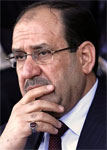
 GulfNews: The removal of Prime Minister Nouri Al Maliki would be an “important part” of the solution to Iraq’s political crisis, a spokesperson for one of the country’s top Shiite clerics said. The statement is the first from any of Iraq’s revered Shiite religious leaders to explicitly endorse Al Maliki’s ouster, and is one of a string of recent announcements indicating a more active national role for the usually taciturn clergy.
GulfNews
The removal of Prime Minister Nouri Al Maliki would be an “important part” of the solution to Iraq’s political crisis, a spokesperson for one of the country’s top Shiite clerics said.
The statement is the first from any of Iraq’s revered Shiite religious leaders to explicitly endorse Al Maliki’s ouster, and is one of a string of recent announcements indicating a more active national role for the usually taciturn clergy.
The speedy formation of a new more inclusive government is seen as a crucial step in countering last month’s onslaught by the Islamic State of Iraq and the Levant (Isil) militants, who have exploited resentment stoked by Iraq’s ineffectual and fractious political leaders.
“That’s part of the solution. An important part,” said Shaikh Ali Al Najafi, spokesperson for his father Grand Ayatollah Bashir Al Najafi, referring to the call for Al Maliki’s exit.
“This is the point of view of the marja Al Najafi,” he told AFP on Monday, a “marja” being one of majority Shiite Iraq’s four most senior Shiite religious leaders, known as the marjaiya.
The most senior of the marjaiya, Grand Ayatollah Ali Al Sistani, through a spokesperson has already called for the “formation an effective government that is acceptable on a … national level [and] avoids past mistakes”.
The June 20 statement stopped short of calling for Al Maliki to step down, but was nonetheless an implicit rebuke for a leader seen by many as sectarian and divisive.
Al Maliki, who came to power in 2006, has vowed to seek a third term after his coalition dominated April elections, but Iraq’s minority Sunni Arabs and ethnic Kurds — and even some fellow Shiites — have demanded his replacement.
Al Sistani had earlier issued a call to arms against Isil insurgents, the marjaiya’s first fatwa for jihad in Iraq for more than 90 years, despite decades of war and bloodshed.
“Now the marjaiya sees a real sustained danger for Iraq, and that Iraq could collapse within hours or days, and needs a stand from all its people to protect the unity of the country,” Al Najafi said, speaking in the Shiite holy city of Najaf.
Iraq was almost torn apart in 2006 and 2007 when the bombing of the Al Askari Shiite shrine north of Baghdad triggered a wave of sectarian slaughter between Shiite militias and Al Qaida allied Sunni militants.
“The size and type of battle is different this time. The number of fighters is different. Daash is different from Al Qaida,” Al Najafi said, referring to Isil. “It’s something more developed than Al Qaida; strength-wise, coordination-wise, organisation-wise, funding-wise. It’s different from before.”
The marjaiya has in the past been more circumspect, and has stayed aloof from Iraq’s graft-ridden and dysfunctional political arena.
But things have changed, Al Najafi said, hinting at more muscular clerical interventions to come.
“When there’s a problem, it’s up to the father to address this problem… the marjaiya is the father,” he said.
“In any crisis, you will have the advice of the marjaiya. And that is for the stability of Iraq, its protection, its unity, and to reassure it and its neighbours and the region.
“With the crises, that we hope won’t continue, it is expected there will be continued advice.”


