


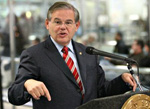
 AP: An influential Democratic senator threatened Thursday to block U.S. arms sales to Iraq if Congress doesn’t get an assessment of Iraqi forces and assurances the weapons won’t fall into the hands of extremist militants. In a testy exchange, Sen. Bob Menendez lashed out at senior State Department and Defense Department officials appearing before the Senate Foreign Relations Committee that he chairs.
The Associated Press
WASHINGTON (AP) — An influential Democratic senator threatened Thursday to block U.S. arms sales to Iraq if Congress doesn’t get an assessment of Iraqi forces and assurances the weapons won’t fall into the hands of extremist militants.
In a testy exchange, Sen. Bob Menendez lashed out at senior State Department and Defense Department officials appearing before the Senate Foreign Relations Committee that he chairs.
The New Jersey senator, who has previously held up the transfer of Apache helicopters to Iraq, said lawmakers haven’t been informed about potential military assistance to Iraq or about its troops’ capability to push back the growing insurgency by rebels calling themselves the Islamic State.
“You know, this committee has jurisdiction over arms sales,” Menendez said. “And my reticence to arms sales to Iraq has in some respects been proven true when in fact we had much of our equipment abandoned and now in the hands of (Sunni extremists).
“So unless you are going to give us a sense of where the security forces are at, moving forward, this chair is not going to be willing to approve more arms sales so they can be abandoned to go to the hands of those who we are seriously concerned about in terms of our own national security.”
The New York Times reported last week that a classified military assessment found it unsafe for Americans to advise Iraqi forces given their infiltration by Sunni extremist informants and Iran-backed Shiite militants. Nevertheless, the State Department’s Brett McGurk told the House Foreign Affairs Committee on Wednesday that options being developed for Obama are becoming more concrete and specific.
Menendez asked McGurk and the Defense Department’s Elissa Slotkin when the administration intended to advise Congress on what steps it is considering.
“We’re still working through those,” Slotkin said, cautioning the senator against using a “leaked half-report” as the basis for his understanding.
“Well, the absence of having information leads me to only publicly reported resources,” Menendez shot back.
Slotkin then replied: “Our intent is to come and brief Congress at the time when we’ve piled through it ourselves.”
Later, she addressed the military’s assessment that the picture was mixed on whether Iraqi battalions were suitable for U.S. assistance.
“We’re finding units where that’s a problem,” she said, without going fully into detail. “We’re finding units where that’s not a problem.”
At the Pentagon, spokesman Col. Steve Warren said the Iraq assessment is ongoing. Officials, he said, are focused on pulling together the most accurate picture possible, not necessarily the quickest.
McGurk, a deputy assistant secretary of state for Iraq and Iran who spent the last seven weeks in Baghdad, said the U.S. was racing to improve its intelligence in Iraq. Iraqi security forces north of the capital are “trying to do some things to fight back” against the insurgency, suffering almost 1,000 casualties, he said.
McGurk also cited political progress in Iraq with the appointment last week of a new parliament speaker and Thursday’s announcement of a new president.
Slotkin, a senior official for policy and international security, and McGurk clashed Wednesday with House members over questions of drone strikes, keeping Iraq whole and whether Washington should demand that Iraqi Prime Minister Nouri al-Maliki step aside.
The Iraqi government, which for months has sought greater air support and counterterrorism assistance, is growing concerned with Obama’s and Congress’ deliberations.
In a letter this week to Menendez, Lukman Faily, the Iraqi ambassador in Washington, cited increased suspicion that the Obama administration’s policy demand to see Iraqi political reforms before providing more assistance was a “conscious strategy for doing nothing.” And in a clear threat of closer cooperation with Iran, Faily said Iraq would have no reason to decline assistance from other countries if it concludes the U.S. isn’t interested in helping.
“Baghdad is getting mixed signals about U.S. intentions, and regrettably, time is not on our side,” Faily wrote.


