


 AFP: Iranian President Mahmoud Ahmadinejad told the visiting Qatari emir the region must resolve issues on its own, saying Western “interference” would complicate the situation, the presidency website reported Friday.
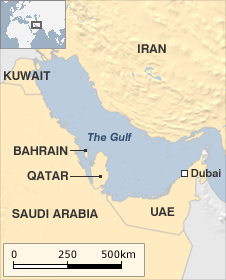 TEHRAN (AFP) — Iranian President Mahmoud Ahmadinejad told the visiting Qatari emir the region must resolve issues on its own, saying Western “interference” would complicate the situation, the presidency website reported Friday.
“Regional countries can resolve (their) issues… without the interference of the West,” Ahmadinejad said Thursday in a two-hour meeting with Sheikh Hamad bin Khalifa al-Thani.
The Qatari emir arrived Thursday night for talks on regional issues with Ahmadinejad, before wrapping up his hours-long visit after midnight.
“The president emphasised that the interference of foreigners and domineering powers in the regional countries’ internal affairs would complicate the situation and make it more difficult,” the website quoted him as saying.
Sheikh Hamad, for his part, said “those who cannot meet the demands of their people and resolve their issues through understanding… are pushing their country and nation as well as the region towards insecurity,” the website reported.
Iran and the Gulf Arab monarchies do not see eye-to-eye on regional crises of recent months, including the uprisings in Bahrain and Syria, which were not explicitly mentioned by the website.
Tehran supports the regime of Syrian President Bashar al-Assad while advocating reforms in its key regional ally. The Gulf countries have denounced Damascus’s deadly crackdown on protesters.
But on Bahrain, Iran has repeatedly expressed its backing for the anti-regime protest movement led by the Shiite majority in the Sunni-ruled island. The Arab states, meanwhile, support the government, and have even provided military support.
Sheikh Hamad’s visit to Tehran marked the first by one of the leaders of Gulf monarchies following the political crisis in Bahrain.
Despite lingering tensions between the Islamic republic and the Gulf Cooperation Council — comprised of Saudi Arabia, Qatar, Kuwait, the United Arab Emirates, Bahrain and Oman — Doha has kept close relations with Tehran.
Qatar has also acted several times as mediator between Tehran and Riyadh.


