


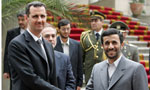
 Washington Pos: From one point of view the connection between our troubles with Syria and Iran is pretty straightforward. The Syrian regime of Bashar al-Assad is Iran’s closest ally, and its link to the Arab Middle East.
The Washington Post
By Jackson Diehl
 From one point of view the connection between our troubles with Syria and Iran is pretty straightforward. The Syrian regime of Bashar al-Assad is Iran’s closest ally, and its link to the Arab Middle East. Syria has provided the land bridge for the transport of Iranian weapons and militants to Lebanon and the Gaza Strip. Without Syria, Iran’s pretensions to regional hegemony, and its ability to challenge Israel, would be crippled.
It follows that, as the U.S. Central Command chief Gen. James N. Mattis testified to Congress in March, the downfall of Assad would be “the biggest strategic setback for Iran in 25 years.” Making it happen is not just a humanitarian imperative after the slaughter of more than 10,000 civilians, but a prime strategic interest of Israel and the United States.
So why are both the Obama administration and the government of Benjamin Netanyahu unethusiastic — to say the least — about even indirect military intervention to topple Assad? In part it’s because of worry about what would follow the dictator. In Obama’s case, the U.S. presidential campaign, and his claim that “the tide of war is receding” in the Middle East, is a big factor.
But the calculus about Syria and Iran is also more complicated than it looks at first. The two are not just linked by their alliance, but also by the fact that the United States and its allies have defined a distinct and urgent goal for each of them. In Syria, it is to remove Assad and replace him with a democracy; in Iran it is to prevent a nuclear weapon. It turns out that the steps that might achieve success in one theater only complicate Western strategy in the other.
Take military action — a prime concern of Israel. Syria interventionists (such as myself) have been arguing that the United States and allies like Turkey should join in setting up safe zones for civilians and anti-Assad forces along Syria’s borders, which would require air cover and maybe some (Turkish) troops. But if the United States gets involved in a military operation in Syria, would it still be feasible to carry out an air attack on Iran’s nuclear facilities? What if Israel were to launch one while a Syria operation was still ongoing?
The obvious answer is that the result could be an unmanageable mess — which is why, when I recently asked a senior Israeli official about a Western intervention in Syria, I got this answer: “We are concentrated on Iran. Anything that can create a distraction from Iran is not for the best.”
Obama, of course, is eager to avoid military action in Iran in any case. But his strategy — striking a diplomatic bargain to stop the nuclear program — also narrows his options in Syria. A deal with Tehran will require the support of Russia, which happens to be hosting the next round of negotiations. Russia, in turn, is opposed to forcing Assad, a longtime client, from power by any means.
If Obama wants the support of Vladimir Putin on Iran, he may have to stick to Putin-approved measures on Syria. That leaves the administration at the mercy of Moscow: Obama is reduced to pleading with a stone-faced Putin to support a Syrian democracy, or angrily warning a cynically smirking Putin that Moscow is paving the way for a catastrophic sectarian war.
At the root of this trouble are confused and conflicting U.S. aims in the Middle East. Does Washington want to overthrow the brutal, hostile and closely allied dictatorships of Assad and Iran’s Ali Khamenei — or strike bargains that contain the threats they pose? The answer is neither, and both: The Obama administration says it is seeking regime change in Syria, but in Iran it has defined the goal as rapproachment with the mullahs in exchange for nuclear arms control.
Obama tries to square this circle by pursuing a multilateral diplomatic approach to both countries. But if regime change in Syria is the goal, Security Council resolutions and six-point plans from the likes of Kofi Annan are doomed to failure. Only a combination of economic and military pressure, by Assad’s opposition or outsiders, will cause his regime to fold.
A collapse, in turn, could undermine the same Iranian regime with which Obama is seeking a bargain. So it’s no wonder Tehran sought to add Syria to the topics for discussion at the last session of negotiations — or that Annan wants to include Iran in a new “contact group” to broker a settlement in Syria.
The Obama administration rejected both proposals — because they are at odds with Syrian regime change. This muddle may delight Vladimir Putin, but it’s not likely to achieve much else.


