


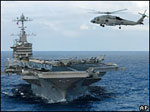
 AP: Although the Navy says the maneuvers are purely defensive and not directed at any country, they are widely seen as a message to Iranian officials who have threatened to block the Strait of Hormuz at the mouth of the Gulf.
The Associated Press
By ADAM SCHRECK
MANAMA, Bahrain (AP) — The admiral in charge of the U.S. Navy’s 5th Fleet on Thursday defended the large American-led naval exercises in the Persian Gulf and other strategic Mideast waterways as a way to ensure stability and security in the region, rebutting Iran’s concerns about what it sees as foreign military meddling.
More than 30 countries are involved in the anti-mine exercises. Although the Navy says the maneuvers are purely defensive and not directed at any country, they are widely seen as a message to Iranian officials who have threatened to block the Strait of Hormuz at the mouth of the Gulf.
Vice Admiral John W. Miller said the participation of such a large number of countries shows there is a broad, common interest in ensuring the region’s sea lanes remain safe. The Navy describes the drills as the largest ever focused on mines in the region.
“We’re prepared to make sure there is stability in the region. We understand that one of the threats that’s possibly presented to us is a threat of mines,” Miller said. “We’ve seen that in history so it’s not unthinkable. And so it’s important on an international basis that we can clear those mines from the water.”
Tehran has previously deployed mines in the Gulf, including one that injured 10 when it blew a hole in the guided missile frigate USS Samuel B. Roberts in 1988. Any attempt by Iran to shut the Strait of Hormuz, the route for a fifth of the world’s oil supplies, would likely include the laying of mines again.
Miller is the commander of the 5th Fleet, which is based in the Gulf nation of Bahrain and is responsible for American naval operations in a broad area stretching across the Middle East from the Horn of Africa to Pakistan.
The anti-mine exercises formally began earlier this week but only got under way at sea on Thursday. Initial operations included communication checks, loading supplies and simulated medical evacuations for mine-disposal divers, according to Lt. Greg Raelson, a spokesman for the Navy’s 5th Fleet
About 20 vessels from just over a half dozen countries, including Britain and Japan, are participating, Navy officials say. Several other nations, including Canada, France and the Netherlands, are sending divers, observers or other personnel.
Iranian officials have said they will be closely monitoring the drills. Tehran earlier this week deployed one of its Russian-made submarines in the Gulf and launched what state media reported was a destroyer scheduled for completion soon.
Iran’s foreign ministry spokesman, Ramin Mehmanparast, reacted to the U.S.-led maneuvers Tuesday by saying Western and other foreign powers were to blame for a lack of security in the region. The outside forces, he said, “trample the interests of countries of the region to secure their own interests and provoke instability and insecurity.”
Besides the Gulf, the U.S.-led exercises are planned in the Gulf of Oman and in the Gulf of Aden, the gateway to the Red Sea that has been a focus of international counter-piracy operations.
The drills will not extend into the Strait of Hormuz itself, which is only 21 miles (34 kilometers) wide at its narrowest point. The width of the shipping lane in either direction is only two miles, separated by a two-mile buffer zone.
“There’s no reason to pressurize a very busy waterway,” Miller said in explaining why operations were not happening in Hormuz. “We’re conducting these exercises … where we can do so without interfering with the normal commerce.”


