


 New York Times: A long and bitter rivalry between Iran’s president and an influential band of brothers in the political hierarchy exploded into the open on Monday, signaling new fractures in the facade of unity as the country confronts worsening economic conditions and isolation over the disputed Iranian nuclear program. The New York Times
By THOMAS ERDBRINK
 TEHRAN — A long and bitter rivalry between Iran’s president and an influential band of brothers in the political hierarchy exploded into the open on Monday, signaling new fractures in the facade of unity as the country confronts worsening economic conditions and isolation over the disputed Iranian nuclear program.
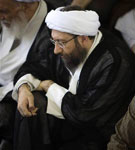
In a letter published by Iranian news sites, President Mahmoud Ahmadinejad accused the head of the powerful judiciary, Ayatollah Sadegh Larijani, of protecting “certain individuals” from prosecution for economic corruption who are widely understood to be high officials, including Ayatollah Larijani’s oldest brother.
Mr. Ahmadinejad also demanded access to Tehran’s Evin prison, to visit one of his aides who has been held for nearly a month. In order to build his case, Mr. Ahmadinejad referred to a range of articles in the Iranian Constitution that explain the powers of the president.
The accusation escalated a simmering conflict between Mr. Ahmadinejad and opponents among influential clerics, parliamentarians and commanders. It followed a decision announced on Sunday by Iran’s judiciary to deny Mr. Ahmadinejad access to the prison — a humiliating slap at the president’s authority.
Mr. Ahmadinejad had wanted to visit Ali Akbar Javanfekr, his press adviser and former head of the official Islamic Republic News Agency, imprisoned since September on a six-month sentence for having insulted Iran’s supreme leader, Ayatollah Ali Khamenei. Mr. Javanfekr’s arrest and conviction had also been seen as a move to curtail presidential powers.
Adding insult to injury, a judiciary statement said Mr. Ahmadinejad had been informed his visit would be “inappropriate” and divert attention from Iran’s economic problems.
Both Mr. Ahmadinejad’s government and his opponents have been trying to cast each other as responsible for double-digit inflation, high unemployment and a devaluation of the national currency. These economic indicators have worsened in recent months with the bite of antinuclear sanctions, which have constricted Iran’s ability to sell oil and do routine banking transactions.
The hostility expressed between the country’s highest leaders, at a time of increasing Western pressure, comes despite repeated calls for political unity by Ayatollah Khamenei.
Mr. Ahmadinejad, in his letter, emphasized his position as the most important directly elected official in the country. He also insisted that under Iran’s Constitution the president has the right to visit a prison.
Analysts said Mr. Ahmadinejad’s public attack on the Larijani brothers reflected his apparent preparation for an increasingly public fight with political enemies. The outcome could determine his influence after his second term ends in July 2013. He is not allowed to run in the June 2013 presidential election.
“Ahmadinejad has created a win-win situation for himself,” said Amir Mohebbian, a political analyst close to Iran’s supreme leader, referring to the president’s demand to enter the prison. “If he is denied access, his opponents will look unreasonable. If he manages to enter Evin, they look weak.”
Iran’s political system is structured around a president and Parliament directly elected from a group of candidates vetted by a council of jurists and Islamic experts, some by the supreme leader and others by Parliament. The supreme leader also has a say in appointing other officials and has final word on all important matters. Mr. Ahmadinejad’s uncompromising management style and choice of controversial advisers has grated on the clerics and led to a debate over his influence.
Mr. Ahmadinejad has been defending his inner circle of advisers against accusations of corruption, black magic and espionage for MI6, the British intelligence service. He is also disliked by Iranians who took to the streets after his disputed his re-election victory in 2009.
Mr. Ahmadinejad personally prevented an earlier attempt to arrest Mr. Javanfekr, which apparently led the judiciary to take the adviser into custody at the precise moment when the president was addressing the United Nations General Assembly on Sept. 26 in New York.
Many of the Shiite clerics and commanders who once supported Mr. Ahmadinejad’s rise to power have turned into bitter enemies and are hoping Mr. Ahmadinejad will quietly sit out the end of his term. Instead, Mr. Ahmadinejad is increasingly trying to portray himself as a man of the people whose policies are obstructed by long-serving officials with selfish interests.
“Mr. Ahmadinejad, by referring to many articles of the Constitution in his letter, is underlining that he represents the people, because they elected him,” said Nader Karimi Joni, an Iranian journalist who has closely followed the power struggle.
After years of accusing former president Ali Akbar Hashemi Rafsanjani and his family of corruption, Mr. Ahmadinejad is now increasingly focusing on the influential Larijani family, whose five brothers all have high positions in Iran’s ruling elite.
The judiciary chief was appointed by Iran’s supreme leader in 2009. An older brother, Ali Larijani, a former top nuclear negotiator, is the head of the Parliament and may run for president next year. Mr. Ahmadinejad recently attacked the Parliament speaker by name at a news conference, saying that Mr. Larijani should help the government instead of trying to blame it for the country’s economic problems.
On Monday the Parliament speaker referred to Mr. Ahmadinejad as “his dear brother” and sought to present the dispute as not personal. “Since our country is a democracy, disagreements are good,” he said according to the Islamic Students’ News Agency.
The oldest Larijani brother, Mohammad-Javad, frequently appears on American television as the head of Iran’s human rights council. In July he was accused in documents published by Alef, an official news Web site of land grabbing. The judiciary then blocked the Web site.
In his letter on Monday, Mr. Ahmadinejad said the decision to punish his aide was unjust and that he wanted to visit Evin Prison to report to the supreme leader on conditions there and “how the nation’s rights are being preserved,” according to the Iranian Students’ News Agency.
Mr. Ahmadinejad also suggested the judiciary had no legal right to stop him. “I have to remind you that in the Constitution, there is nothing that requires asking permission or agreement of the judiciary when it comes to exercising the president’s legal duties,” the agency quoted his letter as saying.


