


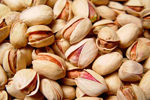
 AP: This should be the time of year that nut shop owner Mohammad Ahmadi counts his profits, after the recent Persian new year holiday when Iranians scarf up huge amounts of their iconic snack, pistachios. The Associated Press
By By NASSER KARIMI
TEHRAN, Iran (AP) — This should be the time of year that nut shop owner Mohammad Ahmadi counts his profits, after the recent Persian new year holiday when Iranians scarf up huge amounts of their iconic snack, pistachios. Instead, he and others in the trade are staring at piles of unsold nuts.
Iranians have rebelled against a nut that is as linked to their national identity as apple pie is to America’s or feta cheese to Greece’s. A Facebook-driven boycott of pistachios has taken off, protesting prices that more than doubled in recent months.
“The number of customers has dropped terribly,” said Ahmadi, looking out at busy streets where few customers turned into his shop in the Salsabil neighborhood of downtown Tehran.
The beloved pistachio has become another casualty of Iran’s sanctions-battered economy. The embracing of the boycott reflects the public dismay over inflation now at 30 percent, ahead of the June presidential election to pick a successor for Mahmoud Ahmadinejad.
Yet, the government, which usually tries to contain Iranians’ anger over the economy, has heartily backed the pistachio boycott — again for reasons tied to the Western-led sanctions over Iran’s nuclear program. Pistachio exports provide a small but important pipeline for foreign revenues at a time when sanctions are squeezing Iran’s oil and gas sales. Authorities say fewer nuts consumed at home means more available to sell abroad.
The pale green nuts are Iran’s top non-oil export, though admittedly they are very distant second. Iran earned at least $750 million last year from exporting the nut, with some estimates as high as $1 billion. That’s a fraction of the around $128 million a day it earns from oil exports. But oil revenues were down some 45 percent last year because of sanctions on the industry, making pistachios an attractively reliable earner.
“Nowadays, any revenue from exports is like a drop of lifeblood for Iran,” said Saeed Leilaz, an economic and political affairs analyst.
Iran is the world’s No. 2 producer of pistachios after the United States, and together the two rivals overwhelmingly dominate the world market in the nut. The U.S. re-imposed a ban on Iranian pistachio imports in 2010, but it had little effect on Iran’s sales since its main customers are in Asia, Europe and the Arab world. In 2012, Iran exported some 110-140 million tons of pistachios, the majority of its production, and the industry employs hundreds of thousands of people.
But at home, Iranians are fuming over the cost of their national snack.
Pistachio prices have soared from about 260,000 rials ($8) a kilo (2.2 pounds) last year to more than 600,000 rials ($17). In some areas, a kilo has reached 800,000 rials, or about $25, according to press reports.
The exact cause for the rapid rise in prices remains somewhat unclear. Iranian pistachio growers do not need to import major parts or machinery, whose costs have skyrocketed with the sinking value of the Iranian rial. The rial is currently trading at more than 35,000 to $1 compared with about 10,000 just two years ago. Prices of all Iranian products have been dragged higher by galloping inflation.
Last month, the head of the pistachio association, Mohsen Jalalpour, said prices at home have been affected by the rising price pistachios get on the international market — compounded by the rial’s fall.
The campaign to boycott the nut was launched on Facebook head of last month’s Persian new year, or Nowruz. Demand for pistachios hits an annual high with the new year celebrations, when the nuts are served on nearly every table. Still, they are a treat, not a staple.
Last year, another Internet-driven campaign tried to fuel a boycott on chicken after a similar price spike. That appeal fell flat because chicken is central to the Iranian diet.
The boycott of pistachios, in contrast, has gained a wide following.
“This is the first time that such a campaign has been answered widely,” said Hamed Shabanali, a specialist in information technology. “Word has spread among ordinary people.”
Another information technology specialist, Mahmoud Tehrani, said the boycott showed “how Facebook and virtual world are effective in the Iranian society, now.”
Leila Alipour, a housewife, said she learned about the boycott from her son’s teacher.
“I will not buy any nut this year,” Alipour said in a Tehran bazaar. “It is too expensive.’
Initally, the government in February responded to anger over the rising prices by banning exports of pistachios to increase stocks at home and reduce prices. But it quickly reversed course, lifting the ban within a week and subsequently backing the boycott when it was launched.
State TV, which reflects the views of the ruling clerics, even paid notice of the boycott in an economics show earlier this month. It reported a survey of 1 million people with 87 percent supporting the pistachio boycott.
Ahmadinejad, in a February television interview, called the boycott a “good job.”


