


 Reuters: Few Iranian presidential elections have been so unpredictable but the next few days will at least narrow down who will stand in the ballot on June 14, for which candidate registration starts on Tuesday and ends on Saturday. By Marcus George and Yeganeh Torbati
DUBAI (Reuters) – Few Iranian presidential elections have been so unpredictable but the next few days will at least narrow down who will stand in the ballot on June 14, for which candidate registration starts on Tuesday and ends on Saturday.
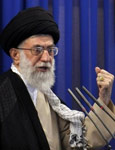
What is certain is that Ayatollah Ali Khamenei, who has held ultimate power as Supreme Leader for 24 years, wants to avoid both the mass protests by reformists that greeted the disputed re-election of Mahmoud Ahmadinejad in 2009, and also more of the public feuding between the outgoing president’s allies and fellow hardliners which has marked Ahmadinejad’s second term.
“The Iranian leadership is so nervous, even if it doesn’t need to be. The 2009 election was an enormous loss of face for the establishment and they’re very concerned about a repetition,” said a Western diplomat based in Tehran.
“Instead of trusting the people, they have put their trust in all sorts of security measures.
Some hopefuls have already declared they will register to run in the first round in six weeks. But many with the strongest chances have been hanging back, weighing their prospects until the last minute, with an eye not only to public opinion but to the Guardian Council of clerics and jurists which can reject any candidacy until a final roster is published around May 23.
With reformist groups largely suppressed over the past four years, the election campaign may reflect little of the debates among Iranians – on how to shore up an economy sagging under Western sanctions, or on foreign policy and the nuclear program that has provoked international concern.
“There is an absence of political discussion, a lack of talk about taxation, the economy or relations with neighboring countries,” the Tehran-based diplomat said.
AHMADINEJAD CAMP
Ahmadinejad, who cannot seek a third mandate, secured an outright win with 62 percent in the four-man first round in 2009, provoking claims of fraud and the biggest protests since the revolution that deposed the Shah in 1979. If no candidate secures more than 50 percent, the runoff will be a week later.
Although Ahmadinejad, 56, is barred by law from running again, his rivals among fellow hardliners committed to resisting a dilution of the state’s Islamist founding principles fear the confrontational incumbent will back a candidate – possibly his close aide Esfandiar Rahim Mashaei – to preserve his influence, even in the face of disapproval from the 73-year-old Khamenei.
“Unlike the first generation of revolutionary elite who played by the rules, Ahmadinejad’s group has consistently pushed against regime red lines and at times even challenged the authority of the Supreme Leader,” said Yasmin Alem, a U.S.-based expert on Iran’s electoral system.
“For them, ambition trumps allegiance to the regime’s principles.”
For his part, Khamenei is turning to a loyal alliance which includes his adviser Ali Akbar Velayati, another ally Gholam-Ali Haddad-Adel and charismatic Tehran mayor Mohammad Baqer Qalibaf, in the hope of securing a quick and painless election win, say analysts and diplomats.
But that informal coalition’s final candidate has yet to be declared – a sign they are still sizing up the competition.
FORMER PRESIDENTS
Even less clear are the intentions of former presidents Akbar Hashemi Rafsanjani and Mohammad Khatami, whose moderate candidacies would radically alter the contest. Both appear reluctant to stand unless given the nod from Khamenei but neither have ruled themselves out.
“I will not enter the field without his consent,” Rafsanjani said this week, according to the Mehr news agency. “If circumstances are such that there will be conflicts and disputes between me and the leader, we will all lose.”
He was president from 1989 to 1997. Khatami, a reformist who succeeded Rafsanjani until 2005, retains much popularity, especially among secular middle classes, youth and women voters.
“Khatami is definitely the most loved,” said a social media consultant in Tehran working for a reformist campaign. “Everyone is waiting for his response. The Qalibaf and Velayati staff are calling his office constantly to see if he will run.”
Both Rafsanjani and Khatami have been sidelined since 2009 and their association with reformist leaders Mirhossein Mousavi and Mehdi Karoubi – losing candidates to Ahmadinejad in 2009 and under house arrest for more than two years – has attracted sharp criticism from hardliners.
Mainstream contenders are not the only ones facing pressure from the authorities. Hooshang Amirahmadi, an academic living in the United States, intends to take part in the election to call for economic reform and ending confrontation with Washington but said that officials have tried to discourage him from standing.
“I was in Tehran two weeks ago and they told me to stay away,” he told Reuters from New Jersey, where he is a professor of planning and public policy at Rutgers University.
“They said that my safety is in danger. They are really nervous and that surprises me.”
(Editing by William Maclean and Alastair Macdonald)


