


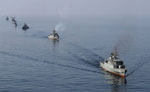
 The Telegraph: Iran has dispatched one of its newest warships to shadow the world’s biggest mine-hunting exercise that has been taking place over the last few days in the Gulf. The Telegraph
Iran has dispatched one of its newest warships to shadow the world’s biggest mine-hunting exercise that has been taking place over the last few days in the Gulf.
By Ben Farmer in the Gulf
The frigate Jamaran cruised to within a mile of the western vessels, placing her “almost on top of” the fleet conducting exercises to secure shipping, naval sources said.
Commanders stressed they did not view the frigate as a threat and said day to day relations with the Iranian navy were cordial, but its presence underlined the sensitivity of the exercise in one of the world’s most strategically important waterways.
The Jamaran, armed with missiles and torpedoes, was built in Iran and launched in 2010, though it is based on a far older design.
Capt Jon Rodgers, commander of the USS Ponce which is one of 35 ships taking part in the exercise, said the Iranian and American navies regularly photographed each other as the two navies – widely seen as potential foes – run up against one another in the congested waters which many believe could be a future flashpoint.
He said: “As long as we are only taking pictures, then we are good.”
The fortnight-long exercise in the Gulf has seen 41 nations take part in drills aimed at protecting shipping from mines, attack by small ships and guarding oil platforms. Most of the vessels belong to Nato members but Australia and some Arab states have also contributed ships.
The organisers say the exercise is purely defensive and deny it is aimed at Iran, but Tehran has repeatedly threatened to close the Strait of Hormuz, a key strategic chokepoint that is just 25 miles wide at its narrowest point, in a move which would send oil process soaring, deal a heavy blow to the world economy – and would provoke a military clash.
Capt Rodgers said: “The mission of mine counter measures is defensive in nature and we are not belligerent here. We are just practising to open up a waterway that may have been mined, so that oil and gas can get out to countries.”
Six British ships are among the vessels taking part in the exercise in which participants are practising securing passage through a stretch of water 250 miles long and 50 miles wide.
The Navy has four mine hunters in the Gulf at any one time, equipped with divers, sonar and Seafox remote controlled underwater drones to find and destroy mines.
Lt-Cdr Ben Vickery, commander of the mine hunter HMS Atherstone, plastic-hulled to prevent it triggering an explosion, said: “It’s something at which the Navy is world leading. It’s an area where we have got great pieces of equipment and we are well supported.”
The congested Strait carries nearly a third of all waterborne oil supplies, amounting to between 15 and 17 million barrels daily. A single mine costing a few thousand dollars could cripple a billion dollar vessel. Mines were used heavily during the Iran-Iraq war and the first Gulf war, and nine nations in the region still keep stocks.
Crews also held drills to protect shipping against the threat of terrorist suicide attack by small bomb-laden boats such as the one which struck the USS Cole in Aden in 2000. The ships bristled with mini-guns and heavy machine guns that would be used to unleash a barrage of fire against waves of attacking small craft, a tactic that has been rehearsed by Iranian Revolutionary Guards.
Cdre Simon Ancona, the Navy officer leading the exercise, said: “It’s not one single threat, it’s anything that could have a catastrophic effect on big value shipping. That’s the thing that has such a huge impact on economies.”
Such an attack would send energy markets into an instant panic he predicted, potentially costing billions.
Right now, though, he said relations with the Iranian navy were “polite, professional and reasonably cordial”.
“In no sense do we feel that either side has an inclination, or indeed is it in their interest, to sabre rattle or be provocative.
“Neither side would wish an incident of miscalculation.”


