


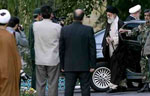
 AP: At the height of Iran’s internal political clashes in late 2011, Supreme Leader Ayatollah Ali Khamenei became so exasperated that he warned the Islamic Republic could someday drop the office of an elected president.
The Associated Press
By ALI AKBAR DAREINI and BRIAN MURPHY
TEHRAN, Iran (AP) — At the height of Iran’s internal political clashes in late 2011, Supreme Leader Ayatollah Ali Khamenei became so exasperated that he warned the Islamic Republic could someday drop the office of an elected president.
The threat was quickly dismissed as a show of force. But it remains an instructive moment to help explain next week’s election to pick the successor to Khamenei’s ally-turned-outcast Mahmoud Ahmadinejad.
Khamenei, the pinnacle of Iran’s Islamic power structure, has come to both fear and debase the country’s highest elected office.
The worries were evident when Khamenei’s election overseers blocked from the ballot former President Akbar Hashemi Rafsanjani and Ahmadinejad’s protege Esfandiar Rahim Mashaei. Both, for very different reasons, were potential boat rockers for the ruling clerics: Rafsanjani because of his prestige, and Mashaei as the political understudy for the combative and power-hungry Ahmadinejad, who openly challenged Khamenei’s authority.
Now, Khamenei and his powerful protectors, the Revolutionary Guard, are turning the prelude to the June 14 vote into their own campaign to diminish and corral the presidency as they try to consolidate control after four rocky years.
The reasons are simple political architecture. The ruling theocracy wants a tidy edifice with less influential branches – the presidency, parliament, university chancellors – boxed into very specific and predictable roles.
The past four years, however, have shaken this structure down to the foundations. The riots after Ahmadinejad’s disputed re-election broke taboos about demanding accountability from Khamenei and his inner circle. Ahmadinejad’s failed attempts to broaden his powers represented an insider mutiny. The rejection of Rafsanjani – a leader of the 1979 Islamic Revolution – suggested insecurity at the highest levels.
“Khamenei is now doing his best to cut the presidency down to size,” said Rasool Nafisi, an Iranian affairs analyst at Strayer University in Virginia. “He only wants to put them in the context of a small box and in the role of a small office.”
A debate last week on Iranian state TV – which is closely directed by Khamenei’s office – appeared to bolster this technocrat message. The eight candidates, most firm loyalists with the ruling system, complained about the quiz show-style format as the moderator pushed at times for just yes-or-no replies on questions about the economy and Iran’s nuclear program.
“Khamenei is making it clear that, from day one, the next president needs to know his place,” Nafisi said.
It’s essentially a back-to-basics reading of the presidential role in Iran. The president is not, by design, a major policymaker. Key decisions such as nuclear advances, intelligence and foreign policy are part of the ruling clerics’ vast mandate. But the presidency has grown brawnier since the somewhat overlapping post of prime minister was dropped in 1989, boosted by Ahmadinejad’s maverick persona and the reform-minded drive by his predecessor, President Mohammad Khatami, for more social and political freedoms.
Khamenei seeks to repackage the presidency into its earlier form: A limited portfolio that mostly entails running the nation’s economy and other day-to-day political affairs.
On Tuesday – with Ahmadinejad looking on – Khamenei gave an indirect, but unmistakable, reminder to the next president of their political boundaries. “Candidates,” he said, “shouldn’t make impossible promises.”
There have been sharper rebukes. In October 2011, Khamenei – who served as president from 1981-89 – became so irritated by Ahmadinejad’s attempt to expand the presidency’s powers that he warned it’s not impossible to “change Iran into a parliamentary system” in which voters no longer elect a president.
In a major contrast to 2009, Khamenei and the Revolutionary Guard claim to have no favorite in the race. Four years ago – before Ahmadinejad’s falling out with the ruling clerics – they openly backed his re-election bid against pro-reform rivals Mir Hossein Mousavi and Mahdi Karroubi, who both joined protesters after the election claiming massive vote rigging. Mousavi and Karroubi have been under house arrest for more than two years.
In this election, however, the candidate slate is packed with establishment-friendly candidates that would likely accept any limits posed by Khamenei. His comments have been interpreted as possibly leaning toward Iran’s top nuclear negotiator Saeed Jalili or, to a lesser extent, his senior foreign policy adviser Ali Akbar Velayati. Members of the Revolutionary Guard, though, could have affinity for former commanders who have run for president before: Tehran Mayor Mohammad Bagher Qalibaf and Mohsen Rezaei.
Another unknown is whether the most prominent moderate, former nuclear negotiator Hasan Rowhani, can get a jump-start with last-ditch support from his ally Rafsanjani and Khatami.
“The fact that the ruling system does not have a unity candidate doesn’t mean that we are on the verge of regime change,” said Scott Lucas, an Iranian affairs expert at Britain’s Birmingham University. “What is means is that the system is in flux.”
How much uncertainly also could determine the degree of intervention by the stake holders in the status quo.
The Revolutionary Guard has the clout to control almost any event in Iran, including crushing the Green Movement protest movement after the 2009 election. The Guard, in a statement last week on its website sepahnews.com, said it does not endorse a candidate this time. But there are suspicions that it already may have played a role by using its influence to knock out Rafsanjani.
In January, one of the Guard’s key advisers, Gen. Yadollah Javani, wrote that it was the Guard’s responsibility to make sure the election is in the Iran’s best interest, equating Western calls for an open candidate field with “sedition” and singling out Rafsanjani for his denunciations of the crackdowns in 2009.
“Ayatollah Khamenei and Revolutionary Guard’s recent efforts to make themselves look like objective, outside players is part damage control, part encouragement to get as many people as possible to turn up to vote,” said Meir Javedanfar, an Iranian-born regional analyst based in Israel. “As far as the (Guard) and the supreme leader are concerned, each vote cast is a vote for the legitimacy of the Islamic Republic, no matter who it’s for.”
—
Murphy reported from Dubai, United Arab Emirates.


