


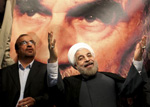
 Reuters: Iranian President Hassan Rouhani, in a television interview, said his country is not seeking war but harshly criticized Israel for bringing “instability” to the Middle East and for questioning his government’s intentions toward nuclear arms.
By Susan Heavey
WASHINGTON (Reuters) – Iranian President Hassan Rouhani, in a television interview, said his country is not seeking war but harshly criticized Israel for bringing “instability” to the Middle East and for questioning his government’s intentions toward nuclear arms.
The comments from the new Iranian president came during the second part of an interview with NBC News that aired on Thursday, just days before he travels to New York for an appearance at the United Nations.
Rouhani called Israel “an occupier, a usurper government that does injustice to the people of the region” and said it “has brought instability to the region with its war-mongering policies.”
But when asked further about Israel, Rouhani also said: “What we wish for in this region is rule by the will of the people. We believe in the ballot box. We do not seek war with any country. We seek peace and friendship among the nations of the region.”
In an earlier part of the interview that aired on Wednesday, Rouhani said Iran would never develop nuclear weapons and that he had “complete authority” to negotiate a nuclear deal with the United States and other Western powers.
Rouhani, who took office in August, reiterated that stance when asked about recent comments by Israeli Prime Minister Benjamin Netanyahu questioning his motives. Israel, thought to be the only nuclear-armed power in the Middle East, is pushing to halt Iran’s nuclear advance, and Netanyahu has called Rouhani a “wolf in sheep’s clothing.”
“We have clearly stated that we are not in pursuit if nuclear weapons and will not be,” Rouhani told NBC.
The interview appears to be the latest signal by the centrist cleric – that has included a recent letter exchange with U.S. President Barack Obama – aimed at improving relations between Iran and the West after years of hostility. Rouhani also appeared to signal support for the pro-democracy uprisings sweeping across the region.
OBAMA ‘OPEN TO A DIRECT EXCHANGE’ -REPORT
The Wall Street Journal reported on Thursday that the Obama administration was preparing for high-level meetings between Iranian and U.S. officials at the U.N. gathering next week and was “open to a direct exchange between” Obama and Rouhani.
The paper quoted the White House officials as saying there were no plans for such a meeting at this stage, but that the two sides had communicated. It would be a significant contact – no American president has met a top Iranian leader since the 1979 overthrow of the Shah and the taking of American hostages at the U.S. embassy in Tehran.
Since his election in June, Rouhani has taken a dramatic shift in tone from the strident anti-Western rhetoric of his predecessor, Mahmoud Ahmadinejad.
But some questions, including Rouhani’s stance on the Holocaust, which killed six million Jews and spurred the creation of Israel, have remained unanswered. Ahmadinejad had previously questioned the Holocaust before the United Nations General Assembly.
Asked whether he also believed the Holocaust was a myth, Rouhani said: “What is important to Iran is that countries, people in the region grow closer and prevent aggression and injustice.”
The White House responded cautiously on Wednesday to the first part of the interview, saying it hopes the new Iranian government will work to reach a diplomatic solution regarding its nuclear program.
The Israeli Embassy in Washington, in a post on Twitter, called the interview part of Rouhani’s “charm offensive.”
Rouhani also appeared to support lifting Iran’s Internet censorship, saying: “We want the people, in their private lives, to be completely free.”
“In today’s world, having access to information and the right of free dialogue and the right to think freely is a right of all peoples, including Iranians,” he told NBC’s Ann Curry, the first Western journalist to interview the new president.
Asked whether that meant Iranians could soon have access to social media websites such as Twitter and Facebook, he said: “The people must have full access to all information worldwide.”
As part of that effort, the government plans to set up a commission for citizen’s rights in the near future, he added.
Such social networking websites have played a key role in the recent uprisings that began with the so-called Arab Spring.
Earlier this week, Iranians gained brief access to Twitter and Facebook before a firewall was put back in place. Iranian officials called it a glitch. Recent Iranian greetings marking the Jewish New Year online also caused a stir.
(Reporting by Susan Heavey; Additional reporting by Matt Spetalnick and David Storey in Washington and Crispian Balmer in Jerusalem; Editing by Vicki Allen and David Brunnstrom)


