


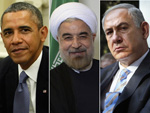
 AP: Just days after the first round of global nuclear talks with Iran, a rift appears to be emerging between Israel and its closest ally, the United States. Israel considers a nuclear-armed Iran a threat to its very survival, citing Iranian references to Israel’s destruction.
The Associated Press
By Josef Federman
JERUSALEM (AP) — Just days after the first round of global nuclear talks with Iran, a rift appears to be emerging between Israel and its closest ally, the United States.
Israel’s prime minister on Sunday called on the U.S. to step up the pressure on Iran, even as American officials hinted at the possibility of easing tough economic pressure. Meanwhile, a leading Israeli daily reported the outlines of what could be construed in the West as genuine Iranian compromises in the talks.
The differing approaches could bode poorly for Israel as the talks between six global powers and Iran gain steam in the coming months. Negotiators were upbeat following last week’s talks, and the next round of negotiations is set to begin Nov. 7.
Convinced Iran is pursuing nuclear weapons, Prime Minister Benjamin Netanyahu believes the Iranians are trying to trick the West into easing economic sanctions while still pushing forward with their nuclear program. Iran insists its program is for peaceful purposes.
“I think that in this situation as long as we do not see actions instead of words, the international pressure must continue to be applied and even increased,” Netanyahu told his Cabinet. “The greater the pressure, the greater the chance that there will be a genuine dismantling of the Iranian military nuclear program.”
Israel considers a nuclear-armed Iran a threat to its very survival, citing Iranian references to Israel’s destruction.
Netanyahu says pressure must be maintained until Iran halts all enrichment of uranium, a key step in producing a nuclear weapon; removes its stockpile of enriched uranium from the country; closes suspicious enrichment facilities and shutters a facility that could produce plutonium, another potential gateway to nuclear arms.
Despite Netanyahu’s warnings, there are growing signs that any international deal with Iran will fall short of his demands.
Over the weekend, U.S. officials said the White House was debating whether to offer Iran the chance to recoup billions of dollars in frozen assets if it scales back its nuclear program. The plan would stop short of lifting sanctions, but could nonetheless provide Iran some relief.
In an interview broadcast Sunday on NBC, U.S. Treasury Secretary Jack Lew said it was “premature” to talk of easing sanctions. But he stopped short of endorsing the tough Israeli line and suggested the U.S. would take a more incremental approach in response to concrete Iranian gestures.
Asked whether he was worried the U.S. might ease the sanctions prematurely, Netanyahu urged against a “partial deal” with Iran. “I don’t advise doing that,” he said on NBC’s “Meet the Press.”
Details from last week’s talks in Geneva have remained tightly guarded, but short-range priorities have been made clear. The U.S. and allies seek to roll back Iran’s highest-level uranium enrichment. Iran wants the West to start easing sanctions.
The Israeli daily Haaretz on Sunday reported what it said were the key Iranian proposals last week.
Citing an unidentified senior Israeli official who had been briefed by the Americans, the newspaper said that Iran is ready to halt all enrichment of 20 percent, limit lower-level enrichment of 5 percent and scale back the number of centrifuges it is operating for enrichment. It also claimed that Iran expressed willingness to reduce the operations of its most controversial nuclear facilities, and perhaps open them to unannounced inspections.
Netanyahu’s office declined comment on the report, though it confirmed the U.S. has kept it updated on the nuclear talks.
The Yediot Ahronot daily newspaper said an “explosion” between Netanyahu and President Barack Obama appears to be inevitable. While Israeli officials are intrigued by the Iranian offer, it said “officials in the prime minister’s inner circle harbor a deep concern … that the American president is going to be prepared to ease sanctions on Iran even before the talks have been completed.”
Ephraim Asculai, a former official of the Israel Atomic Energy Commission and currently a research fellow at the Institute for National Security Studies, said it was too early to talk of a gap between Israel and the United States because the U.S. position on a compromise was not yet clear. He said the most important thing is to prevent Iran from stalling while it moves forward with its weapons program.
But Yoel Guzansky, an Iran expert at the institute and a former national security aide in the prime minister’s office, said there will always be a gap between the U.S. and Israel due to their different military capabilities and the level of threat they face.
Guzansky said Israeli officials realize that they will not get everything they seek, and are pressing a maximalist view in hopes of getting as many concessions out of Iran as possible.
“It appears that the Americans are interested in a scaled approach,” he said. “Israel is very concerned about this and it has good reason to. It’s afraid the deal will become a slippery slope,” he said.
However, Guzansky said Israel has little choice but to rely on the U.S. If there is a deal, it will all but rule out the possibility of unilateral Israeli military action, he said.
“Israel really only has one option,” he said. “The chance it will act alone after the Americans make a deal is miniscule.”
—
Associated Press writer Aron Heller contributed to this report.


