


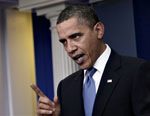
 Reuters: President Barack Obama sought to reassure skeptical U.S. lawmakers on Thursday that any easing of sanctions on Iran that emerges from negotiations could easily be reversed and “ramped back up” if Tehran fails to curb its nuclear program.
By Matt Spetalnick
WASHINGTON (Reuters) – President Barack Obama sought to reassure skeptical U.S. lawmakers on Thursday that any easing of sanctions on Iran that emerges from negotiations could easily be reversed and “ramped back up” if Tehran fails to curb its nuclear program.
In his most direct appeal yet for more time to pursue a diplomatic deal with Iran, Obama urged Congress to hold off on imposing any new sanctions despite concerns on Capitol Hill and among U.S. allies Israel and Saudi Arabia that he is giving away too much.
Obama spoke a day after Vice President Joe Biden, Secretary of State John Kerry and other top U.S. officials warned senators that implementing new sanctions could scuttle the delicate negotiations between Iran and six world powers due to resume in Geneva next Wednesday.
Some lawmakers said after Wednesday’s meetings they were not convinced, and there was no immediate sign that Obama – seeking better ties with Iran after more than three decades of estrangement – had won converts on Thursday either.
“If we’re serious about pursuing diplomacy, then there’s no need for us to add new sanctions on top of the sanctions that are already very effective, and that brought them (the Iranians) to the table in the first place,” Obama told a White House news conference.
“Now, if it turns out they can’t deliver, they can’t come to the table in a serious way and get this issue resolved, the sanctions can be ramped back up,” he said.
An initial agreement seemed close last week, when Kerry made an unexpected trip to the talks in Switzerland. But the negotiators failed to reach a deal and are returning for another round of talks.
Israeli Prime Minister Benjamin Netanyahu warned on Wednesday that a “bad deal” with Iran could lead to war. His aides challenged U.S. assertions that Iran was being offered only limited relief from sanctions.
Underscoring the many obstacles, U.S. Defense Secretary Chuck Hagel staunchly defended Obama’s approach. “I felt sorry for Secretary Kerry because so many people have jumped into this (saying), ‘Well he didn’t get anything and he didn’t get a deal.’ Wait a minute!” Hagel told a defense conference.
“We have political issues. Our partners have political issues,” he said. “So this is going to take time if we’re going to be able to move to somewhere onto a higher … plain of possibility.”
OBAMA ANSWERS CRITICS
At the White House, Obama sought to answer critics who accuse him of preparing to ease sanctions prematurely. He said that in return for Iran’s agreement in a “phase-one” deal to halt its nuclear advances, “we would provide very modest relief at the margins of the sanctions that we’ve set up.”
“But importantly, we would leave in place the core sanctions that are most effective and have most impact on the Iranian economy, specifically oil sanctions and sanctions with respect to banks and financing,” he added.
Obama said that would give world powers a chance to test how serious Tehran is about negotiating a final deal to dispel Western suspicions that it wants to develop a nuclear weapon, something Tehran denies it is seeking.
“It also gives us an assurance that if it turns out six months from now that they’re not serious,” he said, “we can dial those sanctions right back up.”
Speaking later to a Washington think tank, Susan Rice, Obama’s national security adviser, said continued enforcement of the bulk of existing sanctions would mean that “the amount of revenue that Iran will lose during the next six months would far exceed any amounts of relief they might obtain as part of a first-step agreement.”
Obama reiterated that he was leaving “all options on the table” for dealing with Iran – diplomatic code for possible military action. But he warned of “unintended consequences” from any military conflict.
Obama is facing resistance from lawmakers wary of letting up the pressure in negotiations with Iran.
“Sanctions remain the best way to avoid war and prevent a future of Iranian nuclear weapons,” said Senator Mark Kirk, a Republican from Illinois.
Senator John McCain, an Arizona Republican and frequent harsh critic of Obama’s foreign policy, expressed skepticism about the Geneva talks and said the Senate Banking Committee should move ahead with consideration of new sanctions.
But he told Reuters: “I’m not so hell-bent on enacting additional sanctions (by the full Senate), although I think they’re entirely called for. But I am willing to give them a period of time.”
The Republican-controlled House of Representatives passed its version of a new sanctions bill on July 31, just days before Iran’s new president, Hassan Rouhani, took office. Rouhani was elected in June on a platform of conciliation, saying he wanted to ease Iran’s international isolation.
Senators have been debating behind closed doors their version of the bill, which could slash Iran’s oil exports to no more than 500,000 barrels a day. However the banking committee acts, some senators said they might sidestep the panel and insert tough new Iran sanctions into the annual defense authorization bill, which Obama might find hard to veto.
(Additional reporting by Steve Holland, Jeff Mason, Roberta Rampton, Susan Heavey, Patricia Zengerle and David Alexander; Editing by Mohammad Zargham and Peter Cooney)


