


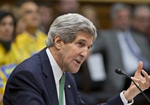
 AP: Lawmakers are raising questions about the secret U.S. diplomacy with Iran that led to last month’s nuclear breakthrough, demanding greater transparency and expressing disappointment at being left in the dark.
The Associated Press
By Bradley Klapper
WASHINGTON (AP) — Lawmakers are raising questions about the secret U.S. diplomacy with Iran that led to last month’s nuclear breakthrough, demanding greater transparency and expressing disappointment at being left in the dark.
The Associated Press has reported that much of the Nov. 24 deal among world powers and Iran resulted from a series of secret meetings between U.S. and Iranian officials. The talks took place in the Middle East sultanate of Oman and elsewhere over eight months.
On Wednesday, Sen. Bob Corker, who recently visited Oman and discussed the diplomatic back-channel with the country’s foreign minister, asked one of the American officials involved to explain the process.
Puneet Talwar, Obama’s senior Mideast adviser who has been nominated for a senior State Department post, responded by saying he met with an Iranian team in Oman in the summer of 2012 and then again in March 2013. He said the talks only heated up after Iran’s moderate president, Hassan Rouhani, took office in August.
“We then had an accelerating pace of discussions bilaterally with the Iranians,” Talwar said at the Senate Foreign Relations Committee hearing. He said the discussions, however, were constantly linked to public, parallel negotiations involving Iran and the U.S., Britain, China, France, Germany and Russia.
“It was made clear,” Talwar said. “It focused exclusively on the nuclear issue, so there were no other side discussions underway. And it was merged, after the conversations gained traction,” with the process involving the global powers.
The agreement last month required Iran to halt and roll back central elements of its nuclear program. That included eliminating its production and stockpiles of higher-enriched uranium, banning the addition of any new centrifuges and barring any work on a heavy water reactor that potentially could produce plutonium for nuclear bombs.
Iran insists its program is designed solely for peaceful energy generation and medical research purposes.
In exchange for its concessions, the U.S. and its partners agreed to ease economic penalties that the Obama administration estimates at about $7 billion.
The administration also promised no new penalties for the six-month duration of the deal, a source of lingering contention with skeptical lawmakers in Congress.
In weekend comments, President Barack Obama played down the significance of the secret talks.
Appearing at the Brookings Institution, he said the contacts were few and focused on seeing how serious Iran was about engaging in serious negotiations.
“They did not get highly substantive in the first several meetings but were much more exploring how much room, in fact, did they have to get something done,” Obama said. As they became more technical, he added, the discussions merged with the public talks with world powers.
Sen. Marco Rubio, R-Fla., made clear his disappointment at not being informed of the private diplomacy.
Rubio asked Talwar if any member of Congress had been briefed; Talwar said he didn’t believe so.
Rubio also asked whether other issues came up in the talks, such as human rights, Iran’s support for Hezbollah and Hamas, and an alleged Iranian assassination plot against Saudi Arabia’s ambassador in Washington.
Talwar said only that the fate of three detained Americans in Iran had been discussed.
On Tuesday, Rep. Matt Salmon, R-Ariz., accused the State Department of deliberately misleading the public. He said such deception raises questions about the administration’s current information on Iran.
“The administration claimed not to be in negotiations with Iran, when they in fact were,” Salmon said, specifically accusing a former State Department spokeswoman of misleading reporters in February by flatly denying the existence of bilateral discussions.
“Your department,” Salmon told Secretary of State John Kerry, “intentionally misled the American people about these negotiations taking place behind closed doors. So how can we have the confidence that the information you’re giving us now is on the level?”
Kerry said he’d look into the comments from nine months ago and respond. He promised complete accountability on his own part.
At a private hearing in the Capitol last week, aides said Rep. Michele Bachmann, R-Minn., demanded to know the details of any Iranian talks involving White House adviser Valerie Jarrett.
Jarrett, who was born in Iran while her father worked there as a development expert, has been the grist of partisan blogs and an Israeli media report suggesting some role in backdoor diplomacy. But the administration has denied any involvement by Jarrett.
At the briefing, Undersecretary of State Wendy Sherman said that in the more than two years she has served as America’s lead nuclear negotiator with Iran, she hasn’t spoken to Jarrett once about the country, according to aides with knowledge of the exchange.
The aides spoke on condition of anonymity, saying they couldn’t talk about a hearing that was partly classified and was supposed to be private.
—
AP Diplomatic Writer Matthew Lee contributed to this report.


