


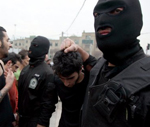
 Independent: In 1979, at the age of two, Laleh Khadivi escaped the Islamic revolution in Iran with her family, emigrating to North America. Identity and exile are her natural themes, and her Kurdish roots have focused her attention so far on Kurdish Iranians.
The Independent
The flight of two Kurdish boys from Iran’s revolution drives a novel of memory and exile
 In 1979, at the age of two, Laleh Khadivi escaped the Islamic revolution in Iran with her family, emigrating to North America. Identity and exile are her natural themes, and her Kurdish roots have focused her attention so far on Kurdish Iranians.
Her first novel, The Age of Orphans, commenced a trilogy, and followed the brutalisation of a Kurdish boy in Iran in 1921. Orphaned by the Shah’s army, he was abducted and taught to hate his own people. The Walking, second in the trilogy, starts in 1979 when the fundamentalist theocrat Khomeini has taken over Iran. Two Kurdish Iranian teenagers are forced to flee. The younger, Saladin, a film buff, dreams of emigrating to America, but the older, Ali, wishes to return home.
The story of the boys’ journey is related in the third person, but whispering in the background are accounts of nameless others: those left behind, those who have escaped earlier, those already settled in Los Angeles and trying to integrate. It is these susurrating voices in first-, second- and third-person (“we”, “you” and “they”), who describe the nightmare horrors of the new Iran: oppression of Jews, Baha’is, Kurds and other minorities; the screeching chastity brigade who vilify unveiled women; medieval punishments such as hanging, stoning and amputation.
They also relate the major events of the revolution: the hundreds killed in the cinema fire in Tehran (now known to have been started by fundamentalists and not, as decreed by the mullahs, by the Shah’s supporters); the American hostage crisis; the Iran-Iraq war; the tens of thousands who were imprisoned, tortured and murdered.
Khadivi is capable of lyricism and poetry, whether conjuring up nature (“the lacy chirp of birds”), elegiac feelings (“memories grow into fictions, stories from a past for which we will soon have no proof”); or sensations associated with travel (“Away from dawn in the direction of night as if the world were a chronometer”). The book is overlong, though, and slow: it’s not necessary to have a football game described, nor a description of how blindfolds on American hostages are “the exact same” as those Saladin saw in Iran, followed by an explanation of the purpose of blindfolds.
In attempting to cover both the fictional story and the facts, details of the former slip and become implausible, such as when drug smugglers offer the boys a ride across the border if they will carry drugs, despite having no papers. Credulity is stretched when poor crop-gatherers deviate into archaeological excavation, lead the boys to a dig where Saladin finds a valuable gold object, and allow the boys to keep it. Nevertheless, this is a brave and haunting book about displacement and identity.


