


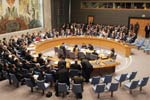
 Reuters: Iran’s foreign minister held a rare meeting with the United States and other Security Council members on Thursday as Tehran faces the possibility of new U.N. sanctions over its nuclear program.
By Louis Charbonneau
NEW YORK (Reuters) – Iran’s foreign minister held a rare meeting with the United States and other Security Council members on Thursday as Tehran faces the possibility of new U.N. sanctions over its nuclear program.
U.N. ambassadors of the United States, Britain, France and Russia did not attend the dinner meeting with Foreign Minister Manouchehr Mottaki organized by Iran’s U.N. mission, but sent lower level diplomats. Washington was represented by Deputy Ambassador Alejandro Wolff.
Most other council members sent ambassadors to the dinner at the Iranian ambassador’s residence in Manhattan. They included Chinese Ambassador Li Baodong, the only chief of mission from the five permanent council members to attend.
Japanese Ambassador Yukio Takasu indicated there had been no concrete outcome. “We are not here to negotiate, we are here to exchange frank general ideas,” he told reporters through an interpreter. “There was no talk about sanctions. What is important is that most Security Council members are here.”
He added that Mottaki reiterated Iran’s position “that it has the right to peaceful uses of nuclear energy.”
Wolff declined to comment except to say that “the dinner was very good.” Other envoys left without speaking to journalists.
Washington does not have formal diplomatic relations with Iran and rarely participates in meetings with Iranian officials outside of the United Nations.
It was not immediately clear when a U.S. diplomat last attended a dinner or reception hosted by Iran.
NEGOTIATIONS AND SANCTIONS
“We see this as an opportunity for Iran to show the council that they’re prepared to play by the rules and meet their obligations,” a U.S. official said before Thursday’s dinner, to explain why Washington was taking part.
“Iran has been offered many opportunities to prove the peaceful nature of its nuclear program,” the official added.
“This meeting is another indication of the lengths the Iranians are going to make their case,” he said. “They clearly recognize that the ongoing efforts in the Security Council and elsewhere are isolating them and doing them harm.”
Another Western diplomat on the council said the meeting proved the council was continuing to pursue a “dual-track approach” with Iran — negotiations combined with the threat of sanctions.
“We want to keep talking,” the diplomat said.
Washington and its Western allies suspect Iran of developing nuclear weapons under cover of a civilian atomic energy program.
Tehran insists that its nuclear ambitions are limited to the peaceful generation of electricity, but has refused to halt sensitive activities that could enable it to develop weapons.
The five permanent members of the Security Council — the United States, Britain, France, Russia and China — and Germany have been negotiating for weeks on a draft resolution that would impose a fourth round of sanctions on Iran for refusing to halt its uranium enrichment program.
The proposal, drafted by the United States, calls for new curbs on Iranian banking, a full arms embargo, tougher steps against Iranian shipping, moves against members of Iran’s Islamic Revolutionary Guard Corps and firms they control and a ban on new investments in Iran’s energy sector.
Diplomats say that both Russia and China have problems with the proposed arms embargo, energy investment ban and other punitive measures included in the U.S. draft.
Washington and its allies had hoped the 15-nation Security Council could vote on a new U.N. sanctions resolution by the end of last month, but diplomats say negotiations could drag on at least until June.
(Editing by Mohammad Zargham)


