


 AFP: China and major international financial institutions have been increasingly willing to cut off Iran over its suspect nuclear program, top US officials assured skeptical lawmakers Tuesday.
By Olivier Knox
 WASHINGTON (AFP) — China and major international financial institutions have been increasingly willing to cut off Iran over its suspect nuclear program, top US officials assured skeptical lawmakers Tuesday.
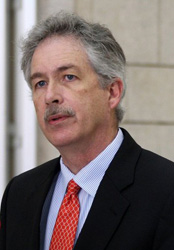
“China is increasingly aware of its own stake in effective international action against Iran and its nuclear ambitions,” the number three US diplomat, William Burns, told the Senate Foreign relations Committee.
But Burns, who is undersecretary of state for political affairs, conceded he was “not sure they (the Chinese) share the same sense of urgency that we and others do, and we’re just going to have to keep pressing hard.”
Burns and the top US Treasury Department official in charge of sanctions against terrorist groups or blacklisted regimes, Stuart Levey, described growing momentum behind sanctions and other efforts to isolate Iran.
“Virtually all major financial institutions have either completely cut off or dramatically reduced their ties with Iran,” said Levey, undersecretary of the treasury for terrorism and financial intelligence.
Levey said firms in the insurance, consulting, energy and manufacturing sectors were making similar decisions, so that “voluntary actions of the private sector amplify the effectiveness of government-imposed measures.”
The two officials testified as Congress moved towards approving, as early as this week, a new round of tough US sanctions against Iran in a bid to drive the Islamic republic to freeze uranium enrichment.
The bill would target non-American firms that sell goods, services or know-how to Iran that help the Islamic republic develop its energy sector, including insurance, financing and shipping companies.
It would also enable US states and local governments to divest from foreign firms engaged in Iran’s energy sector, and would tighten the existing US trade embargo on Iranian goods by curbing the number of exempted products.
Tehran denies Western charges that it is seeking to develop nuclear weapons, but has refused to suspend sensitive uranium enrichment work, which can be a key step towards developing an atomic arsenal.
The officials cautioned lawmakers against seeing the centerpiece of the new sanctions legislation — an effort to choke off Iran’s imports of refined petroleum products — as a cure-all, saying Tehran had braced for the blow.
Oil-rich Iran’s lack of domestic refining capability leaves it heavily dependent on imports to meet domestic demand for products like gasoline and jet fuel.
“This is a vulnerability and we think it’s one that could be exploited,” said Levey. “It’s not a silver bullet.”
Burns said Iran had decreased its dependence on imports to 25 percent of domestic consumption, instead of 40 percent a few years ago.
US lawmakers expressed frustration that the Islamic republic had bucked three previous rounds of UN sanctions and warned that time was running out for settling the tense dispute peacefully.
“We roar like a lion and bite like a puppy. And we need to change that,” said Democratic Senator Bob Menendez, who noted that no company has faced sanctions under a 1996 US law targeting investors in Iran’s energy sector.
“I’ll tell you, we’ve got to get better at this, because we’re going to have a real wreck on hands, and everybody’s going to point back to us,” said Republican Senator Jim Risch.
Mounting financial pressure “will certainly not change the calculations of the Iranian leadership overnight,” said Burns.
The diplomat also urged lawmakers to work with the administration to ensure that the legislation gives President Barack Obama the authority to exempt companies from countries that have helped pile pressure on Iran.
The draft bill allows Obama to waive sanctions only after publicly identifying the companies involved.
Levey urged one senator not to be “overfocused on the bluster” from Tehran dismissing new sanctions.
“We do know that the Iranian leadership is quite concerned,” said Levey. “We’re at the beginning of pursuing this path of accountability.”


