


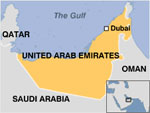
 Reuters: The United Arab Emirates is toughening its posture toward Tehran, worried that the risks of a nuclear Iran on its doorstep may outweigh the cost of a conflict between Iran and the West.
By Cynthia Johnston
DUBAI (Reuters) – The United Arab Emirates is toughening its posture toward Tehran, worried that the risks of a nuclear Iran on its doorstep may outweigh the cost of a conflict between Iran and the West.
The U.S.-allied UAE, like many Gulf Arab states that are home to U.S. military installations, is keen to avoid a war over Iran’s nuclear programme that would almost certainly draw in the Arab countries just across the water from the Islamic republic.
But oil-exporting Abu Dhabi appears increasingly concerned that a nuclear bomb could give non-Arab Shi’ite Iran ammunition to bully its mostly much smaller, Sunni-dominated Gulf Arab neighbours at will.
“The UAE feels threatened,” said Shadi Hamid, research director at the Brookings Doha Centre, adding that the UAE’s strategic approach to Tehran seemed to be shifting some.
“If something isn’t done soon, Iran might be very much on its way to nuclear capability,” he said. “No one will be affected by this more than the Gulf countries. So I don’t want to say they are panicking, but there definitely is a growing level of concern and nervousness.”
As heat rises between Iran and the West, pressure has grown on Abu Dhabi, the seat of the UAE federal union, to show where it stands as it seeks to avoid war while also hoping Washington will not simply let Iran go nuclear and then try to contain the ensuing threat.
It has been a tough line to walk.
The UAE signalled it was no longer as willing as before to serve as a financial lifeline for Iran after the U.N. imposed fresh sanctions on Tehran last month, prompting the central bank to order a freeze on any accounts of dozens of targeted firms.
More spats have emerged as Abu Dhabi publicly comes further on side with the United States, culminating in provocative remarks this month by the UAE’s Washington envoy suggesting his country may support U.S. military action against Iran.
Asked in a forum in Colorado if he wanted the United States to stop the Iranian nuclear programme by force, UAE ambassador Youssef al-Otaiba said: “Absolutely. Absolutely.”
“A military attack on Iran by whomever would be a disaster, but Iran with a nuclear weapon would be a bigger disaster,” Otaiba said, according to an audio recording of his remarks.
His comments, swiftly downplayed by Abu Dhabi, prompted some Iranian lawmakers to propose stopping tourism to the UAE, which also has a multi-billion dollar re-export trade with Iran despite a simmering territorial dispute. No ban was implemented.
“The UAE totally rejects the use of force as a solution to the Iranian nuclear issue and rather calls for a solution through political means,” UAE Assistant Foreign Minister for Political Affairs Tareq al-Haidan said in state media.
“The UAE, at the same time, believes in the need to keep the Gulf region free of nuclear weapons,” Haidan added.
UAE ON FRONT LINE
Otaiba’s words in Colorado, while shocking for their bluntness, simply reflect what many Gulf Arab officials have been saying in private for months, analysts say, adding the UAE has been among the most hawkish.
The tougher posturing may also reflect the stronger hand of Abu Dhabi in steering foreign policy since the Dubai debt debacle and ensuing bailout.
That crisis appeared to weaken the internal political weight of fellow emirate and business hub Dubai, which is more closely tied to Iran through trade.
“It is really a very high risk route to take,” said historian Christopher Davidson, adding other Gulf states were unlikely to follow such a bold course.
“If, God forbid, there is a conflict in the region, the United Arab Emirates is now on the front line,” Davidson said.
The tougher rhetoric has not gone unnoticed by Tehran.
“Regional countries should be careful not to make comments or adopt stances that are more foolish than remarks made by Israeli officials,” Iranian Defence Minister Ahmad Vahidi said in state media shortly after Otaiba’s remarks surfaced.
Even before the recent tiff, Tehran summoned a UAE diplomat in May during a war of words over disputed Gulf islands after the UAE foreign minister likened Iran’s control of them to Israel’s occupation of Palestinian land.
Earlier this month, Iran complained its planes had been denied fuel in Germany, Britain and the UAE, although a UAE source said that was the decision of a multinational firm and not government policy.
Then last week, Iran floated an idea to seek payment in UAE dirhams for its oil exports to Europe to get around sanctions that could block Iranian transactions in the euro.
“Is this a joke?” was the UAE central bank governor’s official response to the news.
But the UAE, whose harder line could help win it favour with Washington, is not likely to take any steps beyond the scope of sanctions, and trade has continued although restrictions may complicate the re-export business.
“It is important to stress that the country will continue to tread carefully in dealing with Iran,” Gala Riani of IHS Global Insight said in a recent note.
Other Gulf Arab states, especially those with significant Shi’ite populations, may share the UAE’s concern over Iran.
While the interests of regional heavyweight Saudi Arabia — with the most military might among all the Gulf Arab states — appear roughly aligned with the UAE’s, most others have stayed well out of the diplomatic fray.
And while Sunni-dominated Saudi Arabia, home to Islam’s holiest site, sees Iran as a political and diplomatic rival and is alarmed at its rising influence in the region, it has recently refrained from any provocative remarks.
“There is a stark realisation that in the case of an outbreak of military conflict in the region the Gulf states, including the United Arab Emirates, would be dependent on the U.S. security umbrella,” Riani said.
The Gulf Arab caution has held even after accusations that Iran was running a spy ring in Kuwait sparked fears Tehran may be scouting out targets for retaliation in the event of a strike. Iran denies the charge.
“Qatar thinks it is Switzerland but plays a diplomatic role, and Kuwait will probably be neutral as well but fall more closely with the Saudis,” said Theodore Karasik, of the Dubai-based Institute for Near East and Gulf Military Analysis. He added that Bahrain would also ultimately follow Saudi’s lead.
(Additional reporting by Frederik Dahl; writing by Cynthia Johnston; editing by Philippa Fletcher)


