


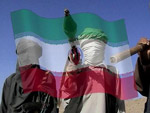
 USA TODAY: For months, top U.S. military leaders have accused Iran of supplying weapons and training to Taliban fighters battling American and Afghan troops. What should be done about it is in debate.
USA TODAY
By Aamer Madhani, USA TODAY
WASHINGTON — For months, top U.S. military leaders have accused Iran of supplying weapons and training to Taliban fighters battling American and Afghan troops. What should be done about it is in debate.
Gen. Stanley McChrystal, the former top commander in Afghanistan, said shortly before he resigned last month that there is clear evidence that Iran is arming and training the Taliban.
Defense Secretary Robert Gates said in March that the Iranians were playing a “double game” inside Afghanistan by striving for good relations with Kabul while undermining the U.S. effort. Weeks later, Adm. Mike Mullen, chairman of the Joint Chiefs of Staff, said there was evidence that Iran was smuggling weapons into Afghanistan.
The U.S. military has not made public evidence supporting its suspicions, but some analysts say that if the allegations are true, that means Iran and the Taliban are willing to work with a traditional religious Muslim rival to get the Americans.
“If the Taliban is getting support from Iran, they know that it’s not out of some love for them,” said Mohsen Milani, an Iran scholar at the University of South Florida. “It’s only because they are being used as useful idiots to do the dirty work that Iran doesn’t want to do itself or that Iran is not capable of doing.”
The Taliban is led by Sunni Muslim clerics who imposed harsh Islamic law on Afghanistan until their ouster by a U.S.-led invasion in 2001.
Iran is a nation of largely Shiite Muslims, viewed as apostates by the Taliban.
The relationship between the Taliban and Iran has been violent at times. In 1998, Taliban terrorists abducted and killed 11 Iranian diplomats in Mazar-e-Sharif, and tens of thousands of Afghan refugees fled to Iran during the Taliban’s rule.
However, Iran is known to support Sunni organizations. The U.S. State Department says Iran provides funds and weapons to Hamas, the Sunni regime in Gaza designated a terror group by the European Union and the United States. The Pentagon has said Iran has helped link al-Qaeda to other terror groups.
James Phillips, a Middle East analyst at the conservative Heritage Foundation in Washington, said Iran’s aid to the Taliban is dwarfed by the amount of arms and financial support flowing to the Taliban from Pakistan, a U.S. ally. But he said it’s important for the Obama administration to not ignore Iran’s actions.
“At some point, there might be a need for military action against Iran, but it’s not going to be over this,” Phillips said.
He suggested that instead of a military strike, the United States should consider arming Kurdish separatist groups in Iran or pressing the United Nations to condemn Iran’s actions.
“Iran is presenting the United States with [more evidence] to support taking action against them,” he said.
Though Iran may be helping the Taliban kill Americans, it would not want to see the Taliban return to power, experts say. And the Taliban doesn’t like the idea of Iran gaining influence in western Afghanistan with the country’s minority Hazara and Tajik communities, said Gary Sick, a former National Security Council official and a professor at Columbia University.
“They hate each other, but that doesn’t mean they won’t cooperate on a particular project,” he said.
Reuel Marc Gerecht, a former Middle East specialist at the CIA and senior fellow at the Foundation for the Defense of Democracies in Washington, agrees that Iran doesn’t want a replay of the chaos that followed the Taliban takeover in 1996. But he says Iran has much to gain if it could help push the Americans out.
“The distaste for the Americans being in Afghanistan easily exceeds whatever fears that the Iranians have about a post-American Afghanistan,” Gerecht said.
Milani said Iran’s leadership strategy may be to inflict “controlled and slow-bleeding” on the U.S. military.
“Iran wants America to bleed a bit, but it does not want the bleeding to be so severe that it would cause retaliation by the U.S., or it would jeopardize the overall situation in Afghanistan or create a serious friction with the (President Hamid) Karzai government,” Milani said.
John Bolton, who served as U.S. ambassador to the United Nations during the Bush administration, argues that the totality of Iran’s policies — its nuclear program, support for Hezbollah in Lebanon and Shiite militias in Iraq, as well as its backing of the Taliban — demonstrate that the United States should adopt a tougher policy on Iran.
“It provides more and more justification that the only long-term solution in Iran is regime change,” Bolton said.


