


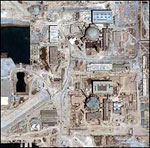
 Bloomberg: Russia will switch on Iran’s first nuclear power plant tomorrow as the government seeks to bolster its global influence by acting as a power broker between the U.S. and its European allies and the Persian Gulf nation.
By Yuriy Humber and Lucian Kim
Aug. 20 (Bloomberg) — Russia will switch on Iran’s first nuclear power plant tomorrow as the government seeks to bolster its global influence by acting as a power broker between the U.S. and its European allies and the Persian Gulf nation.
Rosatom Corp., the state-run Russian company building the plant at Bushehr in southern Iran, plans to open it after repeated delays over 15 years of construction.
Iran, under United Nations sanctions because of concern it is concealing a nuclear weapons program, will become the first Middle East country to produce atomic energy when Bushehr goes online. Russia, which joined U.S.-led efforts to tighten the UN embargo, is using the opening to soothe Iranian anger while keeping a potential energy rival isolated.
“As long as there’s an Iran problem, the West will need Russia,” said Rajab Safarov, head of the Center for Contemporary Iranian Studies in Moscow. “And Russia will feel like an important geopolitical player.”
Relations sank to a low in June after Russian President Dmitry Medvedev called on Iran to stop its “irresponsible behavior” and Russia supported new UN sanctions. Iranian President Mahmoud Ahmadinejad responded by saying countries that helped the U.S. pressure Iran would be considered “enemies.”
International sanctions have prevented Iran from realizing its potential as an energy supplier, especially to Europe, where Russia holds 25 percent of the natural-gas market. Iran is the world’s fourth-largest oil producer and has the second-biggest gas reserves after Russia, according to data compiled by BP Plc.
‘Keeping Up Tensions’
“Just keeping up tensions in the region is beneficial to Russia because they keep up the price of crude oil and block Iranian gas from the world market,” said Mikhail Korchemkin, director of East European Gas Analysis, a Malvern, Pennsylvania- based industry consultant.
Russia signed a $1 billion contract for the Bushehr plant in 1995. Completion was delayed by payment disputes and questions about Iran’s other nuclear projects.
“The Russians are looking to get Bushehr started to show the world that even under tough conditions they can stand by their commitments,” Iranian Vice President Ali Akbar Salehi, told the state-run Islamic Republic News Agency on Aug. 17. It will be a “thorn in the eye of ill-seekers.”
Moscow-based Rosatom will provide the fuel for Bushehr and dispose of spent nuclear material under the supervision of the UN’s International Atomic Energy Agency.
“The Bushehr technology cannot be used for military purposes even if the authorities wanted to,” said Anton Khlopkov, director of the Center for Energy and Security Studies in Moscow. “The Iranian government will try to use Bushehr to show the population how advanced the economy is.”
Enrichment Concern
The U.S. and its allies say they recognize Iran’s right to civilian nuclear power. They have focused their criticism on a uranium enrichment plant at Natanz, a second being built at Qom and a heavy water reactor under construction at Arak, all of which could be used to produce material for nuclear weapons.
Russia’s involvement in Bushehr “underscores that Iran does not need its own enrichment capability if its intentions, as it states, are for a peaceful nuclear program,” White House spokesman Robert Gibbs said Aug. 13 in Washington.
Iran says it will need to enrich uranium as it builds 20,000 megawatts of nuclear capacity to meet the needs of a growing population. That compares with about 23,000 megawatts in Russia.
The argument isn’t convincing because it would be easier for Iran to import enriched uranium than produce it, said Vladimir Sazhin of the Institute of Oriental Studies in Moscow.
Diplomatic ‘Market-Maker’
Concern about enrichment helped push Russia to support a fourth round of UN sanctions. U.S. President Barack Obama has made a joint position on Iran a priority in his “reset” of relations with Russia.
“Russia’s been the market-maker in Iran diplomacy,” said Cliff Kupchan, a senior analyst at Eurasia Group, a New York- based political risk consultant. “They’ve been the key on UN resolutions. Russia is both the carrot and stick provider.”
Russia has similarly dangled the delivery of S-300 anti- aircraft missiles in front of Iran, with the Kremlin sending conflicting signals over whether the deal would fall under the new UN sanctions. The missiles could be used to protect Iran’s nuclear facilities from air strikes.
Russia shouldn’t overplay its hand because Iran is a potential arms buyer and could meddle in the mainly Muslim North Caucasus region, said Ruslan Pukhov, director of the Center for Analysis of Strategies and Technologies in Moscow. Russia may have lost $4.5 billion in future contracts because of the delay in delivering the S-300 missiles, according to Pukhov.
Gas Contracts
While Moscow-based OAO Gazprom, Russia’s biggest energy company, is considering deals in Iran, sanctions limit opportunities. Restrictions on investment prevent Iran from joining international pipelines, building liquefied natural gas projects and competing for European gas contracts.
The completion of Bushehr is the minimum needed for Russia to maintain relations with Iran, said Fyodor Lukyanov, editor of the Moscow-based journal Russia in Global Affairs.
“If Russia had refused to finish Bushehr it would have ruined relations,” he said. “The question is if relations will develop any further.”


