


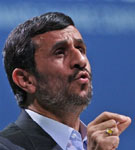
 AFP: The leaders of China and Russia on Wednesday pressed President Mahmoud Ahmadinejad to show more cooperation to resolve the Iranian nuclear standoff, in a rare meeting at a regional security summit.
by Aleks Tapinsh
ASTANA, June 15, 2011 (AFP) – The leaders of China and Russia on Wednesday pressed President Mahmoud Ahmadinejad to show more cooperation to resolve the Iranian nuclear standoff, in a rare meeting at a regional security summit.
Presidents Hu Jintao and Dmitry Medvedev held separate meetings with Ahmadinejad but delivered a similar message of the need to improve dialogue, as the Iranian president again denounced the West as “slavers and colonisers”.
Host Kazakh President Nursultan Nazarbayev urged the Shanghai Cooperation Organisation (SCO), a security group regarded as a NATO rival founded in 2001, to take a more active role in ensuring regional security.
But most attention was focused on Ahmadinejad, who was absent from last year’s SCO meeting in Tashkent after the UN Security Council agreed sanctions against Iran and was making a rare appearance at a big international meeting.
China urged Iran to participate in the six-party talks on nuclear energy and “take substantial steps in respect of establishing trust” and “speed up the process of dialogue,” the Chinese state news agency Xinhua reported.
Tehran used to rely on Moscow as a dependable ally in its standoff over the nuclear programme but relations have rapidly deteriorated as Russia increased pressure on Iran after Medvedev became president.
Medvedev urged Ahmadinejad to take a more constructive approach in the standoff, Russian Foreign Minister Sergei Lavrov said, expressing concern that the issue had fallen off the radar amid the uprisings in the Arab world.
“Although we are also very concerned about what is happening in this region, we feel it is wrong to forget about the deadlock that remains around the Iranian nuclear programme,” Russia’s top diplomat said.
“The Iranian president was told of the need for more constructive cooperation with the ‘six’ (world powers) — and, most importantly, of improving transparency in his contacts with the IAEA (UN nuclear watchdog),” he added.
Iran’s Foreign Minister Ali Akbar Saleh, quoted by his country’s official news agency IRNA, said the two presidents “insisted on settling the Iranian nuclear question through dialogue.”
“The Iranian president once again insisted on the fact that Iran is ready to settle our country’s nuclear question through dialogue” with the major powers.
In a characteristically firebrand speech to the summit peppered with rhetorical questions, Ahmadinejad launched a new call for a wholesale shake-up of the world order, which he said was “managed and run by slavers and colonizers of the past.”
Turning to his audience of ex-Soviet and Asian leaders he asked: “Have any of us used an atomic bomb against the defenceless citizens of any other country?”
Returning to his past claims that a conspiracy could have been behind the September 11 attacks on the United States, Ahmadinejad added:
“Have any of our countries played a part in the creation of 9/11 under whose pretext Afghanistan and Iraq were invaded and more than one million people have been killed or wounded?”
On the unrest shaking the Arab world, the member states agreed a declaration expressing concern about the instability but supporting “the drive of regional states in the path of democratic development in accordance with their specific cultural and historical characteristics.”
Nazarbayev said in his opening address that the organisation had to become a greater force after it showed little capacity to react during last year’s uprising and ethnic violence in member state Kyrgyzstan.
“Our organisation did not and could not make any decisions,” he said.
With Afghan President Hamid Karzai attending as a guest, Nazarbayev also expressed alarm that drug trafficking in Afghanistan had increased by a factor of ten in the past decade.
The SCO’s membership includes the ex-Soviet Central Asian states and with the likes of India, Iran, Mongolia and Pakistan attending meetings as observers, its summits bring together an eclectic gathering of world leaders.
The summit is the latest in a string of big international meetings hosted by Astana, Kazakhstan’s shiny new capital, which in the last months has already welcomed a summit of the OSCE and the annual meeting of the EBRD.


