


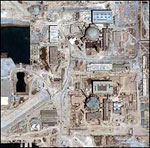
 Reuters: An Iranian effort to show increased openness about its disputed nuclear program is doing little to dispel Western suspicions about Tehran’s atomic ambitions, with one Vienna-based envoy dismissing it as a “charm offensive.”
By Fredrik Dahl
VIENNA (Reuters) – An Iranian effort to show increased openness about its disputed nuclear program is doing little to dispel Western suspicions about Tehran’s atomic ambitions, with one Vienna-based envoy dismissing it as a “charm offensive.”
Diplomats accredited to the U.N. nuclear watchdog said they believed it would once again highlight concerns about possible military aspects to Iran’s atomic work in its next quarterly report, due to be submitted to member states in coming days.
“I expect it will be a bit tougher than the last one. Still a number of outstanding matters related to possible military dimensions that Iran refuses to answer,” a Western envoy said.
Other diplomats painted a similar picture, saying Tehran had failed to address the International Atomic Energy Agency’s core concerns and appeared to be playing for time.
“There is nothing particularly virtuous and wonderful about being transparent and open about activities that are in violation of U.N. Security Council resolutions,” a senior European diplomat said. “It still very much sounds to me like an establishment that is stalling for time.”
Western nations suspect Iran is trying to use its nuclear program to develop atomic weapons. The Islamic Republic has denied the charge, saying it wants to produce nuclear energy.
The Vienna-based IAEA, tasked with ensuring that nuclear technology is not diverted for weapons, has often complained about Iran’s lack of cooperation over allegations of military-linked atomic activity.
In previous reports, the U.N. agency has urged Tehran in vain to provide prompt access to sites, equipment, documents and people relevant for its probe.
In a move that Iran said showed the country’s “100 percent transparency and openness,” it allowed a senior IAEA inspector to tour the country’s main atomic facilities last month, including one for developing advanced enrichment machines.
The IAEA has been trying since 2008 to gain access to sites linked to the manufacture of centrifuges used to refine uranium — material which can have both civilian and military purposes — but Iran had until now ignored the requests.
Tehran has also signalled some flexibility in responding to IAEA questions, with state television quoting a top nuclear official as saying the agency should present “their main claims” together with relevant evidence and documents.
But the Western envoy suggested Iran was merely using an old tactic to ward off any harsher international pressure on the country, while forging ahead with sensitive nuclear work.
“The Iranians’ recent charm offensive has not changed the agency’s view on what Iran still needs to do,” he said.
URANIUM STOCKPILE
For several years, the IAEA has been investigating Western intelligence reports indicating Iran has coordinated efforts to process uranium, test high explosives and revamp a ballistic missile cone to accommodate a nuclear warhead.
Iran rejects the allegations as forged and baseless.
IAEA Director General Yukiya Amano has taken a more hard-nosed approach than his predecessor, Mohamed ElBaradei, saying in his first report on Iran in 2010 he feared it may be working now to develop a nuclear-armed missile, not just in the past.
Tehran’s refusal to halt enrichment has provoked four rounds of U.N. sanctions on the world’s No. 5 oil exporting state, as well as tighter U.S. and European Union restrictions.
Since talks between global powers and Iran foundered in January, Russia has advocated a phased plan in which Tehran would address concerns that it may be seeking nuclear weapons, and be rewarded with an easing of sanctions.
But the Islamic Republic is showing no sign of heeding U.N. demands to curb its nuclear activities.
In late August, Iran said it had begun moving enrichment centrifuges to an underground bunker near the holy city of Qom as part of a push to triple output capacity of higher-grade enriched uranium, a development Washington called “troubling.”
Iran only disclosed the existence of the subterranean Fordow site to the IAEA in September 2009 after learning that Western intelligence agencies had detected the mountain site.
Transferring enrichment activity to Fordow could offer greater protection against any attacks by Israel or the United States, which have both said they do not rule out pre-emptive strikes to stop Iran developing nuclear weapons.
Western analysts say that by producing 20 percent enriched material Iran has taken a significant step closer to the 90 percent threshold suitable for atom bombs. Iran says it needs the material to fuel a Tehran research reactor.
“Iran has no logical need for large stockpiles of 20 percent enriched uranium,” a U.S.-based think tank said.
“Having such a large stockpile on hand and located within a fortified structure is more suited towards planning for the contingency of a breakout to nuclear weapons,” the Institute for Science and International Security (ISIS) added.
(Editing by Karolina Tagaris)


