


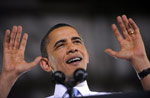
 AFP: US President Barack Obama on Wednesday warned Iran that the window for diplomacy to solve a nuclear showdown was “shrinking,” stiffening his rhetoric ahead of looming new talks on the issue. By Stephen Collinson
WASHINGTON (AFP)— US President Barack Obama on Wednesday warned Iran that the window for diplomacy to solve a nuclear showdown was “shrinking,” stiffening his rhetoric ahead of looming new talks on the issue.
Obama sent a public message to Iran as preparations went ahead for a new round of dialogue between global powers and the Islamic Republic, amid rising fears of a military confrontation, possibly triggered by Israel.
“In the past, there has been a tendency for Iran in these negotiations to delay, to stall, to do a lot of talking but not actually move the ball forward,” Obama said at the White House.
“I think they should understand … that the window for solving this issue diplomatically is shrinking.”
“We will do everything we can to resolve this diplomatically but ultimately we’ve got to have somebody on the other side of the table who is taking this seriously and I hope that the Iranian regime understands that,” he said.
Obama also predicted at a joint news conference with British Prime Minister David Cameron that a punishing new set of sanctions on Iran would “begin to bite even harder this summer” and would further hurt Tehran’s economy.
He also reiterated that his intention was not to contain Iran but to actively prevent it from getting nuclear weapons, signaling he would use military action if diplomacy failed.
Obama reasons that an Iranian bomb is an unacceptable national security risk because it could trigger an arms race in the Middle East, raise the risk of proliferation and embolden “terrorists” under Iranian protection.
Both Obama and Britain have signaled that they do not believe that the time is right for military action against Iran’s nuclear program yet, amid fierce speculation about the possibility of an Israeli strike in the next few months.
In a letter to EU foreign affairs chief Catherine Ashton earlier Wednesday, Iran formally requested a date and venue for talks with the P5+1 group of world powers, comprising the United States, Russia, China, France, Britain and Germany.
It said it was interested in talks “without preconditions and with the goal of having long-term cooperation.”
In the past, Iran has refused to discuss its nuclear program at the talks. Iran denies the program is designed to manufacture weapons.
Cameron backs Obama’s condemnation of “loose talk” over war with Iran, which has boiled over speculation on Israel’s intentions and been fanned by Republican presidential candidates.
He praised Obama’s “tough, reasonable approach” which he said had united the world to call for Iran to live up to international nuclear obligations and to prove it was not bent on manufacturing nuclear weapons.
Obama’s warning appeared to lend credibility to a report in Russia’s Kommersant daily on Wednesday which suggested that Washington had warned Iran the talks, expected next month, were a last chance to avoid military strikes.
The paper said that Secretary of State Hillary Clinton had asked Russian Foreign Minister Sergei Lavrov to make the situation clear to the Iranian authorities when she met him in New York.
Iran’s nuclear program was at the center of a high stakes visit to Washington last week by Israeli Prime Minister Benjamin Netanyahu, who told Obama Israel must remain the “master of its fate” and reserved the right to use force.
The Obama administration has signaled that it does not yet believe Iran has taken a choice to develop a nuclear weapon.
Israel, which sees an Iranian nuclear weapon as a threat to its existence, however believes that Iran may be on the cusp of “break out” capacity — the moment when it could quickly produce weapons-grade uranium.
Washington says it has up to a year to decide on how to respond should Iran decide to begin enriching uranium to weapons-grade quality. Israel does not share that timetable.
Israel meanwhile is worried that the increasingly tough US and European sanctions on Iran’s central bank and its vital petroleum industry will not convince Tehran to renounce a nuclear arsenal.


