


 New York Times : Iran took defiant steps on Monday in response to the intensified Western sanctions aimed at stifling its oil exports, announcing legislation intended to disrupt traffic in the Strait of Hormuz.
The New York Times
By RICK GLADSTONE
 Iran took defiant steps on Monday in response to the intensified Western sanctions aimed at stifling its oil exports, announcing legislation intended to disrupt traffic in the Strait of Hormuz, a vital Persian Gulf shipping lane, and testing missiles in a desert drill clearly intended as a warning to Israel and the United States.
The legislation calls for Iran’s military to block any oil tanker heading through the strait en route to countries no longer buying Iranian crude because of the European Union embargo, which took effect on Sunday.
It was unclear whether the legislation would pass or precisely how Iran would enforce it, given that the United States Navy’s Fifth Fleet patrols the strait. Pentagon officials have said Iran’s military is capable of closing the strait temporarily, and the Obama administration has warned that any such move would constitute a “red line” that would provoke an American response.
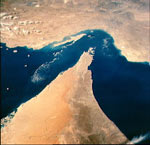
The strait, connecting the Gulf of Oman to the Persian Gulf, is the conduit for one fifth of the world’s oil supply and has been called the world’s most important “oil chokepoint” by the United States Department of Energy.
Iranian news services quoted Ibrahim Agha-Mohammadi, a member of Parliament’s National Security and Foreign Policy Committee, as saying the panel drafted the legislation “as an answer to the European Union’s oil sanctions against the Islamic Republic of Iran.”
The European embargo, along with new American restrictions that took effect on Friday, are intended to penalize Iran for refusing to suspend all uranium enrichment. Western nations and Israel suspect the enrichment program is aimed at creating the ability to make nuclear weapons, which Iran denies. While high-level talks have faltered, a meeting of lower level negotiators is planned for Tuesday.
In the second saber-rattling step, Iranian news agencies announced that the elite Revolutionary Guards Corps had begun three days of missile testing in the desert region of the central province of Semnan. Brig. Gen. Amir Ali Hajizadeh, a commander of the exercises, was quoted as saying they were intended as practice responses to attacks by “adventurous nations,” a reference to Israel and its most important ally, the United States.
Israel, which regards Iran as its most lethal enemy, has not ruled out conducting pre-emptive military strikes on Iranian nuclear facilities if it concludes that the Iranians are on the verge of nuclear bombmaking capability.
The Islamic Republic News Agency quoted General Hajizadeh as saying “if any form of incident happens, Iran’s ground-to-ground missiles will rain like thunderbolts upon the aggressors.”
Iran’s foreign minister, Ali Akbar Salehi, said Iran had learned to cope with Western economic retribution since the 1979 Islamic revolution, and that no amount of sanctions would pressure Iran to change its position on uranium enrichment, which the Iranians regard as their legal right.
“We have been subject to sanctions for 33 years and these sanctions are an addition to the previous ones and this is not a problem,” Mr. Salehi was quoted as saying by Press TV, a government-funded Web site.
Western oil industry analysts estimate that Iran’s export of oil, the country’s economic lifeline, has plunged by as much as 40 percent this year compared with a year earlier, partly in anticipation of the sanctions that have just taken effect. A roughly 20 percent decline in oil prices over the past few months has further aggravated economic pain in Iran.
The price weakness reflects a global economic slowdown and increased sources of supply from other prominent oil producers, notably Saudi Arabia, Iraq and Libya.
Artin Afkhami contributed reporting.


