


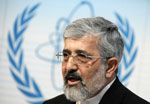
 Reuters: Iran’s envoy to the U.N. atomic agency will leave his post next month, in what may be a further sign of new President Hassan Rouhani’s desire for a fresh start with the outside world over its disputed nuclear program.
By Fredrik Dahl
VIENNA (Reuters) – Iran’s envoy to the U.N. atomic agency will leave his post next month, in what may be a further sign of new President Hassan Rouhani’s desire for a fresh start with the outside world over its disputed nuclear program.
Ali Asghar Soltanieh’s surprise departure comes after Rouhani last Friday appointed former Foreign Minister Ali Akbar Salehi, seen as a pragmatist, to head Iran’s atomic energy organization, replacing a hardliner in the job.
Rouhani has pledged to improve Iran’s ties with world powers in an attempt to ease stringent international sanctions on the Islamic Republic over its nuclear program, which it says is entirely peaceful but the West suspects has military aims.
Soltanieh, an energetic diplomat in his early 60s who often rails against the West in meetings of the Vienna-based International Atomic Energy Agency (IAEA), had been leading so far fruitless negotiations with the agency.
“I confirm that my mission, assignment, will be over on September 1,” nuclear physicist Soltanieh told Reuters on Wednesday. “I’m proud that I’ve served my country and I’m grateful for their trust and I will go back home of course to serve my country.”
It was not immediately clear whether his move was planned or was a more recent decision by Tehran.
One Western diplomat accredited to the IAEA said Soltanieh “was the face” in Vienna of the previous Iranian government and that his replacement may be another indication of Rouhani seeking a new atmosphere in Tehran’s international dealings.
“If the president wants a new dynamic maybe he needs a new person” as ambassador to the U.N. agency, the diplomat said.
NEW START
Meanwhile, the appointment of Salehi – also a former ambassador to the IAEA – was seen as a further signal that Rouhani intends to pursue a more flexible approach to Iran’s nuclear dispute with the West than his predecessor Mahmoud Ahmadinejad, a hardliner.
IAEA chief nuclear inspector Herman Nackaerts, Soltanieh’s counterpart in the talks, is due to retire next month, meaning both sides may enter any new round of discussions with new chief negotiators. The next meeting has yet to be scheduled.
There was also no word yet on who would replace Soltanieh, who has held the job for some seven years, diplomats said.
The IAEA has for years been investigating allegations that Iran has carried out research and tests relevant for the development of nuclear weapons, a charge the country denies.
Western diplomats have accused Iran of stonewalling the IAEA’s inquiry, and Tehran’s relations with the U.N. agency have become increasingly strained in recent years.
One European diplomat said Soltanieh still seemed to have cordial personal relations with IAEA officials in talks that got under way in early 2012 on what the U.N. agency calls the “possible military dimensions” to Iran’s nuclear program.
“He is skilled and knowledgeable,” the diplomat said.
Rouhani is still deciding who will lead broader diplomatic talks with world powers on Iran’s nuclear program, the Foreign Ministry said on Tuesday, more than two months after the moderate cleric was elected.
The Iran-IAEA talks are separate, but still closely linked, to the negotiations between six major powers and Iran aimed at finding a diplomatic solution to the decade-old dispute and avert the threat of a new Middle East war.
Western states and Israel say Iran’s atomic energy program is in fact an attempt to attain a nuclear weapons capability. Tehran denies the charge and says it only wants the technology to generate electricity and for medical research.
(Editing by Alison Williams)


