


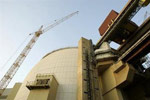
 AFP: Iran on Monday finally takes control of its civilian nuclear reactor at Bushehr on the Gulf coast, a project begun 35 years ago by Germany, wracked by setbacks, and finished by Russia. TEHRAN (AFP) — Iran on Monday finally takes control of its civilian nuclear reactor at Bushehr on the Gulf coast, a project begun 35 years ago by Germany, wracked by setbacks, and finished by Russia.
The Islamic republic’s atomic agency chief Ali Akbar Salehi confirmed on Sunday that Russia would hand over the 1,000-megawatt plant Monday.
He also said he expected work to start soon on a second plant upon completion of talks with Moscow, saying: “Negotiations are continuing and are well-advanced.”
“Work will start soon,” he added, without saying when.
Construction of the Bushehr facility began in the 1970s with the help of German company Siemens, which quit the project after the 1979 Islamic revolution over concerns about nuclear proliferation.
Work was also hampered by the 1980-1988 Iran-Iraq war, before Russia agreed in 1994 to take up the construction baton of the plant due originally for completion in 1999.
Moscow also agreed to provide its fuel for 10 years, with the supply deal committing Tehran to returning the spent fuel, amid Western concerns over its controversial uranium enrichment programme.
Bushehr was finally finished more than a decade late and inaugurated in 2010, but it did not come into service until 2011 because of technical problems.
Some Iranian officials accused Russia of foot-dragging under pressure from the United States, which had sought in vain to prevent the project from reaching fruition.
Tehran’s atomic ambitions have been at the heart of its troubled relations with world powers for years.
Israel and the West suspect that Iran’s declared peaceful programme of uranium enrichment masks a covert nuclear weapons drive, a charge vehemently denied in Tehran.
Construction of the Bushehr facility, located east across Gulf waters from southern Kuwait, has sparked concern among Gulf Arab states, but both Iran and Russia say it is subject to International Atomic Energy Agency (IAEA) safeguards.
Salehi will join Russian officials at the plant for Monday’s official handover ceremony.
The official IRNA news agency quoted him as saying on Sunday that “for another two years it will be under Russian guarantee and a number of Russian experts will remain in place to give advice and technical assistance”.
Bushehr, under the control of the UN watchdog the IAEA, was finished by Russia’s state nuclear corporation Rosatom.
Foreign experts say Tehran attaches great importance to Monday’s handover, as it illustrates its self-sufficiency in harnessing civilian nuclear power, no longer dependent on outside help.
But neighbouring nations and the West have concerns about Bushehr, given its location in an earthquake-prone zone on the Gulf, especially since Japan’s Fukushima disaster of 2011.
As the crow flies, the plant is far closer to Iran’s neighbours than it is to its own capital, one foreign diplomat pointed out, adding: “The prevailing winds go towards Dubai, and marine currents towards Kuwait.”
Iran sits astride several major fault lines and is prone to frequent earthquakes, some of which have been devastating.
On April 9, a 6.1-magnitude quake rocked the south, with an epicentre around 100 kilometres (60 miles) from Bushehr.
However, a Rosatom spokesman at the time said “they did not even feel the tremors”.
Western concerns also include Iranian engineers’ ability to run a power plant constructed of components from three different sources — German, Russian and domestic.
Russia’s Kommersant daily reported on September 11 that Moscow was ready to sign an accord with Tehran to build a second reactor at the Bushehr power plant.
Iran has said it wants to produce 20,000 megawatts of electricity from nuclear power, which would necessitate building 20 1,000-megawatt reactors.


