


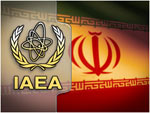
 AFP: Following a diplomatic frenzy in New York, Iran was due Friday to hold talks with the UN atomic agency, their 11th such meeting but the first since Hassan Rouhani’s election.
By Simon Sturdee
Vienna (AFP) — Following a diplomatic frenzy in New York, Iran was due Friday to hold talks with the UN atomic agency, their 11th such meeting but the first since Hassan Rouhani’s election.
The International Atomic Energy Agency regularly inspects Iran’s nuclear activities and every quarter its reports outline a continued expansion in defiance of UN Security Council resolutions.
Western countries want the IAEA to keep a closer eye in order to better detect any attempt by Iran to “break out” and produce enough highly-enriched uranium for a nuclear bomb.
But the subject of Friday’s talks is the IAEA’s wish for Iran to address allegations that before 2003, and possibly since, it conducted research work into making an actual nuclear weapon.
The agency has failed in 10 meetings since early 2012 to press Iran to grant it access to personnel, sites and documents related to these activities, set out in a major November 2011 report by the IAEA.
The allegations were based in large part on information provided to the IAEA from spy agencies like the CIA and Mossad, intelligence which Iran rubbishes and complains it has not even been allowed to see.
The sites include the Parchin military base where the IAEA wants to probe claims that scientists conducted explosives tests that would be “strong indicators of possible nuclear weapon development”.
Western countries have accused Iran of literally bulldozing evidence at Parchin, and IAEA head Yukiya Amano said in June that heavy construction work spotted by satellite means “it may no longer be possible to find anything even if we have access”.
Providing some hope that the negotiators might be 11th time lucky is that under Rouhani, Iran has been sounding considerably more conciliatory than under his more hardline predecessor Mahmoud Ahmadinejad.
It will also be the first such gathering involving Iran’s new envoy to the IAEA, Reza Najafi, who arrived in Vienna earlier this month professing a “strong political will” to engage.
Rouhani, himself a former nuclear negotiator, told the Washington Post this week that he hoped to reach a deal with world powers in three months.
On Thursday new Foreign Minister Mohammad Javad Zarif held a meeting with counterparts from the five permanent members of the UN Security Council plus Germany (the P5+1 or E3+3) at the UN General Assembly, including US Secretary of State John Kerry.
Iran said in New York that it hoped to seal a deal on its nuclear program within a year as its foreign minister held the historic talks with Kerry.
Kerry shook hands and met briefly one-on-one with a smiling Zarif on the sidelines of the United Nations in one of the foes’ highest-level encounters since the 1979 Islamic Revolution.
World powers will meet again for talks with Iran on its suspect nuclear program on October 15 and 16 in Geneva after a breakthrough meeting Thursday, the EU’s foreign policy chief Catherine Ashton said in New York.
This diplomatic track is separate to those of the IAEA, concentrating more on Iran’s current activities, most notably uranium enrichment, with Tehran seeking an easing of painful UN and Western sanctions.
But a deal with the IAEA on probing claims of past weaponisation work is a key part of the jigsaw needed to finally peacefully resolve the standoff over Iran’s nuclear work after a decade of trying.
“The area where Iran is most willing and able to make concessions is the area of transparency and that means more cooperation with the IAEA,” said Mark Fitzpatrick from the International Institute for Strategic Studies.
“I think that this will be a significant meeting, but it won’t necessarily mean that if they strike a deal there (in Vienna) that they will be willing to strike a deal with the P5+1,” he told AFP.


